

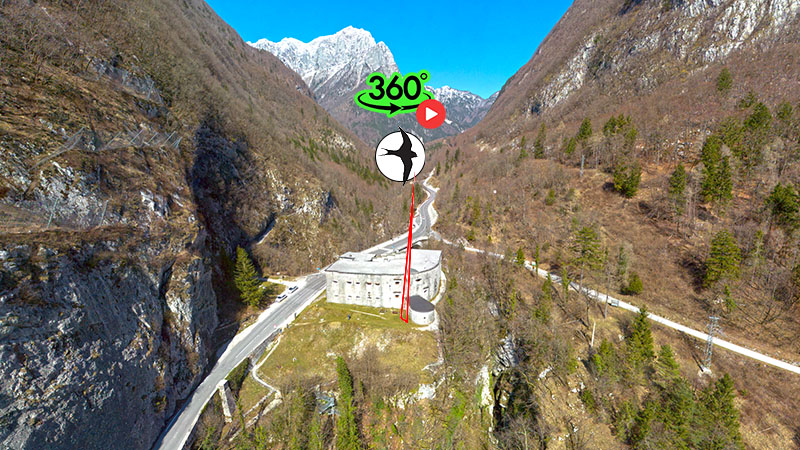
The appearance and purpose of Fort Kluže have changed repeatedly over the centuries, mirroring the shifting political powers that controlled the Bovec region. The fort guards one of the most important strategic passages in the Upper Soča Valley—at the narrowest, gorge‑like section of the Koritnica River, where the landscape itself forms a natural defensive gateway.
The first fortification on this site was built by the Venetians in the second half of the 15th century. It was a simple wooden structure, erected as protection against Ottoman incursions that threatened the region at the time. Because the passage was highly exposed, the Venetians soon recognized the need for a stronger defence. Thus, in the early 16th century, they constructed the first stone fort, which was subsequently repaired and reinforced several times over the following centuries.
In 1797, during the Napoleonic Wars, the fort experienced one of its most dramatic episodes. As Austrian forces retreated before the advancing French army, they burned and demolished the structure to prevent it from falling into enemy hands. Only under Austro‑Hungarian rule did the site regain its strategic importance: between 1881 and 1882, a new, modernized fort was built, and its appearance has remained almost unchanged to this day. It was named Flitscher Klause (the Kluže of Bovec). Its primary purpose was to control the route from the Bovec basin across the Predel/Predil Pass into the interior of the Austro‑Hungarian Empire.
When the Isonzo Front opened in 1915, the front line stabilized in the immediate vicinity of the fort. Thanks to the steep cliffs of Rombon rising above it, Kluže was shielded from direct Italian artillery fire. It therefore became an important rear‑area stronghold, housing command posts, supply units, storage rooms, and support facilities. During this period, the fort was expanded with numerous auxiliary structures, including a small power plant, a water pumping station, observation posts with searchlights, and other installations essential for wartime operations.
In the years leading up to the Second World War, the fort gradually fell into disrepair and was partially abandoned. Today, however, Fort Kluže has been revitalized as a significant cultural and historical monument. It now houses a museum with permanent and several temporary exhibitions that present the turbulent history of the fort and the wider Bovec region.