

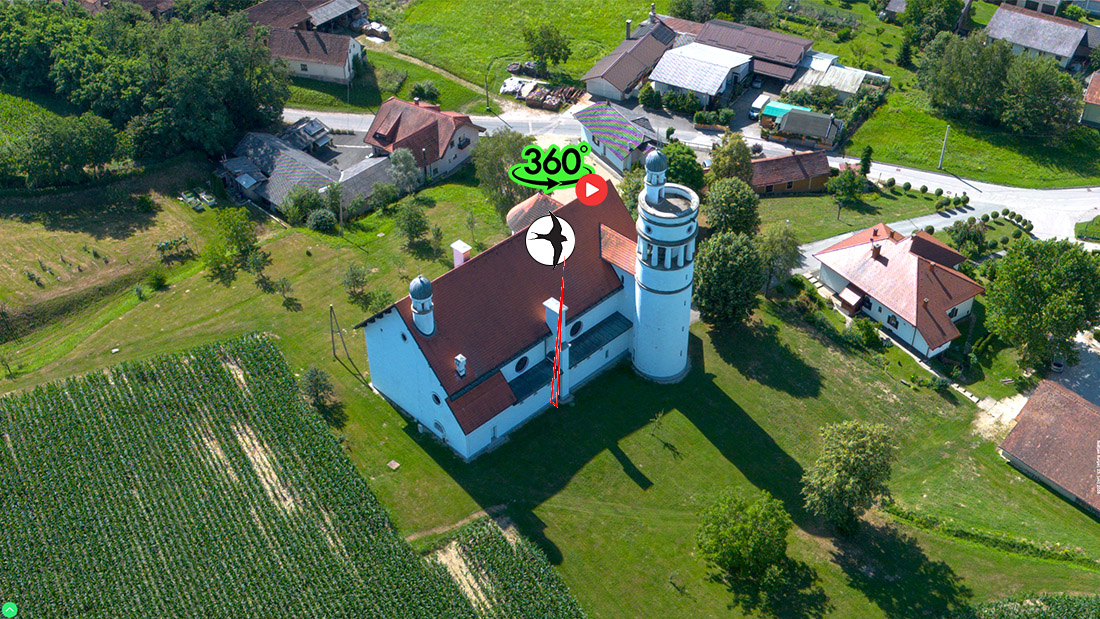
Bogojina – Plečnik’s “White Dove” Among the Hills of Goričko
Bogojina, a clustered settlement on the southern slopes of the Goričko region, is a place where the Pannonian landscape unfolds in wide, gently undulating transitions between lowland and hill country. Its position is distinctly transitional: to the north, the terrain rises into the characteristic ridges of Goričko, while to the south it opens into the flatlands along the Ledava River. This duality – the hilly relief and the open plain – has shaped both settlement patterns and economic life for centuries. Bogojina developed on a slight elevation that offered protection from flooding and provided a clear view over the surrounding fields, meadows, and orchards. The layout of the village is compact and clustered, with a core formed along former local paths and crossroads, while more dispersed farmsteads appear on the outskirts, typical of the zone between Goričko and the lowland.
Historically, Bogojina has been woven into the broader currents that marked the development of Prekmurje. First mentioned in 1208, it belonged in the Middle Ages to extensive landed estates that managed agricultural production and collected dues. Agriculture was the foundation of life: crop farming, livestock breeding, viticulture on sunny slopes, and various crafts tied to local materials and Pannonian tradition. In 1688 Bogojina obtained market-town rights, a milestone that elevated its status. The market became a centre of trade, craftsmanship, and local administration, accelerating the settlement’s development and strengthening its role in the wider region.
During the Habsburg Monarchy, Bogojina retained its agrarian character but gradually integrated into new economic flows, especially after transport links improved in the 19th century. The transition from feudal structures to modern administrative systems brought changes in land ownership, farming methods, and social life. After the First World War, when Prekmurje became part of the Kingdom of Serbs, Croats and Slovenes, Bogojina gained new administrative functions, schools, associations, and infrastructure that connected it with Murska Sobota and other centres. After the Second World War, the settlement developed into a stable local community that preserved its Prekmurje identity, linguistic particularities, and cultural patterns.
Today Bogojina remains a place where centuries-old agrarian traditions, the Pannonian landscape, and historical memory intertwine. Its position on the southern slopes of Goričko gives it a distinctive character – calm, open, yet firmly rooted in the cultural and historical fabric of Prekmurje.
But in the 20th century, it became home to one of the most important works of modern sacred architecture in Slovenia – the Parish Church of the Ascension of the Lord, designed by Jože Plečnik.
A Church That Embraces History
One of the most distinctive features of the church in Bogojina is its dual structure: the new church, built between 1925 and 1927, literally embraces the apse of the old Romanesque church from the 14th century. Plečnik refused to demolish the old structure; instead, he incorporated it into the new composition as a precious core carrying the memory of the place.
-
The entrance to the church leads through the preserved portal of the old church,
-
while above the medieval nave rises the choir loft of the new church, creating a dialogue between centuries.
This architectural gesture reflects Plečnik’s deep respect for tradition and his belief that new architecture should grow from the old, not erase it.
The Bell Tower – A Circular Symbol in the Pannonian Landscape
The new church features a bell tower with a circular floor plan, an unusual form in Slovenian architecture. With this, Plečnik created a vertical accent that rises gently above the rolling landscape. The tower acts as a beacon in the Pannonian plain, visible from afar and unmistakably characteristic.
Plečnik and Parish Priest Ivan Baša – A Creative Partnership
The church was built during the tenure of parish priest Ivan Baša (1875–1931), an essential collaborator who understood Plečnik’s vision and gave him the freedom necessary to create such an original sacred space.
The Interior – A Dialogue of Stone, Wood, and Folk Art
Plečnik designed the interior to be bright, airy, and symbolically rich. He used materials familiar to him, yet interpreted them in a distinctly Pannonian way.
-
The columns, altars, baptismal font, pulpit, and communion table are made of Podpeč marble, a stone Plečnik often used in Ljubljana.
-
The oak ceiling is adorned with ceramic plates crafted by local potters from Filovci and Bogojina.
-
The main altar is decorated with ceramic jugs, also made by local artisans.
With these elements, Plečnik infused the church with the spirit of Pannonian folk art, elevating it to the level of sacred symbolism. The church thus becomes not only an architectural work but also a gallery of local craftsmanship.
Artistic Furnishings – Sculptors and Painters in Harmony with the Space
The church is enriched by works of notable Slovenian artists:
-
The statue of Christ on the façade and the statue of St. Joseph on the side altar were created by the sculptor Lapuh from Ljubljana.
-
The painting of the Ascension above the main altar and the Stations of the Cross are works by academic painter Janez Mežan.
These artworks complement Plečnik’s architecture and create a cohesive sacred experience.
Preservation and Restoration
The church has been carefully maintained:
-
the exterior was repainted in 1999,
-
the interior restored in 1998.
These efforts preserved its original brightness, clarity, and symbolic strength.
France Stele – Recognition from the Highest Authority
One of Slovenia’s most important art historians, Academician France Stele, wrote that this church should be counted among the most important and most interesting architectural works of our homeland. His assessment confirms that Bogojina is not merely a local sacred monument but a national architectural treasure.
A Church as a Symbol of the Pannonian Soul
Plečnik’s church in Bogojina is more than architecture. It is a symbol of Pannonian identity, a place where:
-
Romanesque heritage,
-
modernist vision,
-
folk art,
-
and spiritual depth
come together in a single building that locals affectionately call the “white dove”—a reference to its purity, brightness, and the sense of peace it radiates over the hills of Goričko.