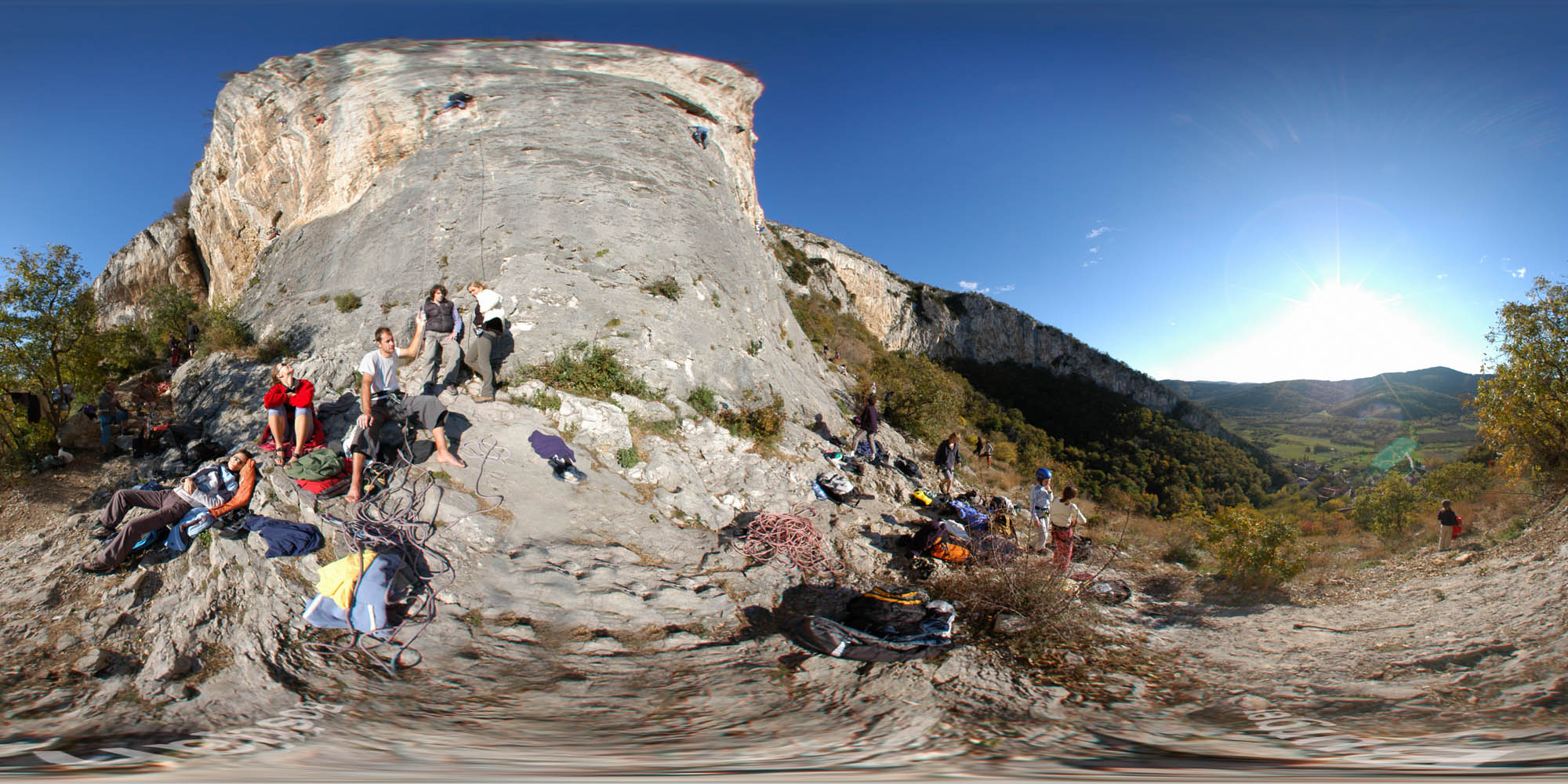

Osp lies on the southwestern edge of Slovenia, nestled at the base of a narrow valley beneath the monumental cliffs of Kraški rob (the Karst Edge), where the flysch landscape of the Slovenian Istria abruptly transitions into an elevated limestone plateau. This fault step is the result of the tectonic underthrusting of the Adriatic-Apulian foreland beneath the External Dinarides, which caused the uplift of carbonate layers and created the distinct geomorphological feature known today as the Karst Edge. This edge is most pronounced right above the valley of the Osp River: the limestone is thrust over the flysch, leading to a combination of overhangs, rock shelters, natural bridges, and scree slopes due to the differing resistance of the rocks.
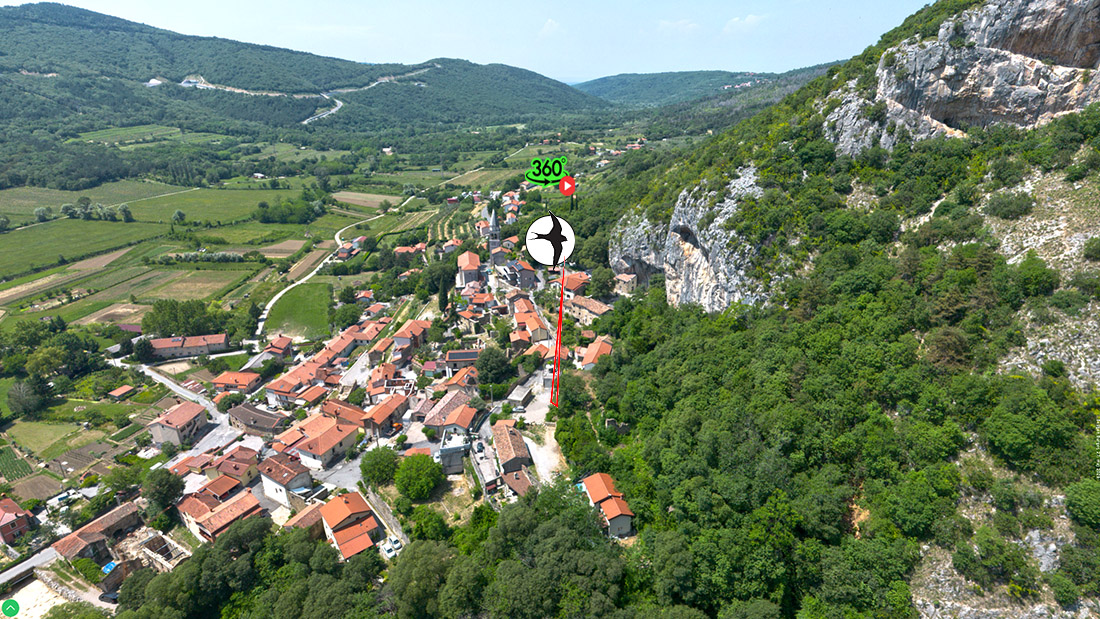
The geomorphology of Osp is thus a direct consequence of tectonic uplifts, fracturing of the limestone, and intense corrosion, which create vertical walls, karren, caves, and collapse dolines. In the cliffs above the village lies the Grad cave, where the Osp River originates; the cave is both a major geomorphological and historical element, as it preserves the remains of a medieval fortification.
Osp is one of the oldest Slovenian settlements. It was first explicitly mentioned in 1067, placing it among the oldest continuously inhabited villages in Slovenia. Its location under the natural protection of overhanging cliffs allowed early settlement, as confirmed by archaeological remains found near the Grad cave. The village core is nucleated, intertwined with narrow streets and characteristic Istrian-Karst architecture, which has been preserved due to its isolated position and traditional building style.
The history of Osp is remarkably turbulent. In the Middle Ages, the Grad cave served as a refuge from Ottoman incursions, and later during the Venetian-Austrian conflicts. The Church of St. Thomas, standing at the edge of the village, was built in the 18th century and represents the central cultural monument of the village. In the 19th and early 20th centuries, Osp was a vibrant cultural center: it once had around 800 inhabitants, three active choirs, and a brass band. In the first half of the 20th century, the village also experienced political tension – the locals revolted against fascist groups in 1921, which led to violence and the burning of homes.
Rock climbing in Osp began to develop in the second half of the 20th century, when climbers discovered the exceptional quality of the limestone walls. The first routes were established in the Big Wall (Velika stena), and later climbing expanded to Mišja peč, which is now one of the most important European climbing venues. Osp became internationally renowned due to its technically demanding routes, the impressive height of its walls (up to 200 m), and its exceptional natural scenery.