

Ljubljana Castle – A Historical Symbol Above the City
On the central hill, rising above Ljubljana like a natural amphitheater, stands Ljubljana Castle – a place where history, legend, architecture, and modern city life intertwine. The Castle Hill is strategically located above the confluence of the Ljubljanica and Gradaščica rivers, which created ideal conditions for settlement as early as prehistoric times. Archaeological finds confirm that the hill was inhabited during the Hallstatt era, almost a millennium before the first written mention of the castle.
First Settlements and Early Development
The oldest traces of human presence on the castle hill date back to the Iron Age, when a fortified settlement stood here. The Romans included the area in Emona's defense system, although there is no evidence of a monumental Roman fortress on the summit itself. In the early Middle Ages, the hill became a vital defensive point, leading to the creation of the first fortress in the 11th century.
In written records, the castle first appears in 1144 as Laybach and in 1146 as Luwigana, confirming its role in the administrative and military system of the Patriarchate of Aquileia and later the Bishops of Freising.
Ownership Through History
11th–13th Century: Owned by the Bishops of Freising, who controlled important trade routes.
14th Century: Passed under Habsburg rule, gradually transforming into a provincial fortress.
16th Century: Gained reinforced defensive functions during the era of Turkish incursions and peasant revolts.
17th–18th Century: Lost military significance, becoming the seat of provincial offices and later a prison.
Architectural Evolution
The castle attained its current appearance after the great earthquake of 1511, when it was thoroughly rebuilt into a Renaissance fortress. Romanesque remains are still visible in the core, while St. George's Chapel remains a precious example of Gothic architecture.
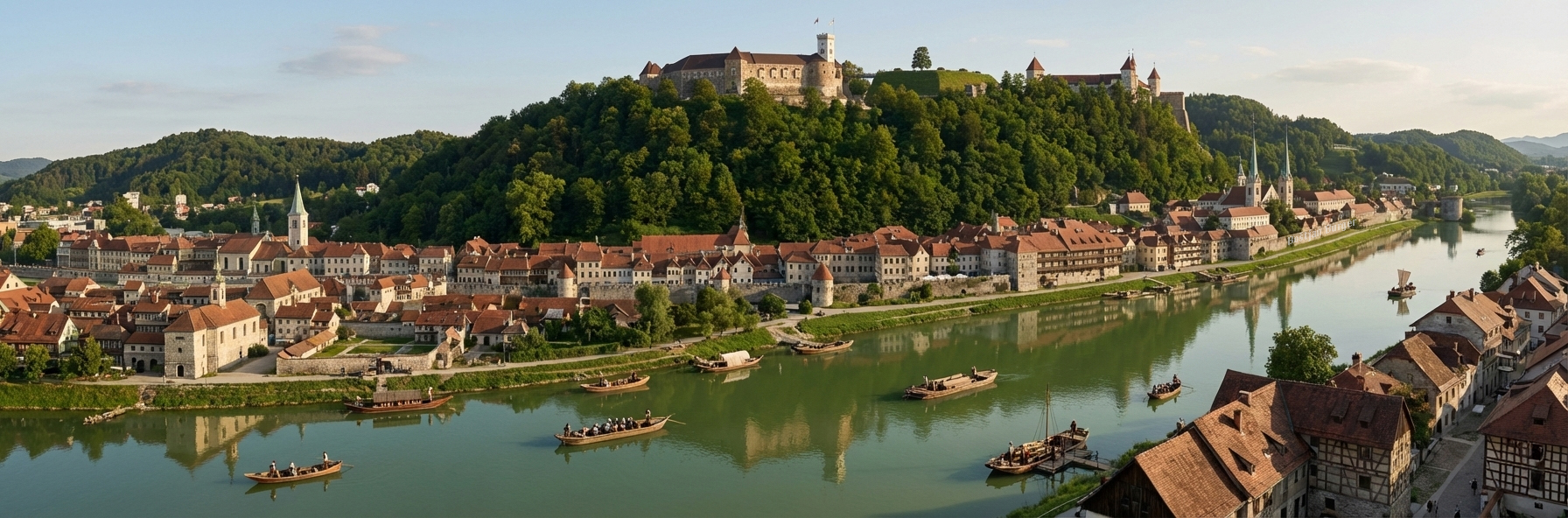
(Simulation of a 17th‑century view of Ljubljana, a mosaic of 360‑degree panoramas (Boštjan Burger) + Valvasor’s depiction of Ljubljana + AI, www.mojaslovenija.si)
The Outlook Tower, now one of Ljubljana's most recognizable silhouettes, was built in 1848 on the site of an old defensive tower and renovated in 1982.
Ljubljana Castle During the Illyrian Provinces
Between 1809 and 1813, when Ljubljana was the capital of the Illyrian Provinces, the castle served primarily as a military and administrative outpost for the French authorities. During this period, it was an important symbol of the new political order, which brought modernization to education, the judiciary, and administration.
The Castle in World War I and II
World War I: Used as a military facility and a prison, primarily for prisoners of war and political prisoners of the Habsburg Monarchy.
World War II: Under Italian and later German occupation, the castle became a prison once again, housing many members of the resistance movement, making it an important place of remembrance today.
After World War II
After 1945, the castle lost its military function. For decades, it fell into disrepair and was partly used as social housing. It was not until the 1960s that systematic restoration began, reaching its peak in 1997 when most of the renovation work was completed.
Present-Day Purpose
Today, Ljubljana Castle is a cultural, tourist, and social center:
Wedding halls and protocol rooms,
Museum collections and exhibitions,
Concerts, theater performances, and film evenings,
Restaurants and a café,
An Outlook Tower with one of the most beautiful views of Ljubljana and the Kamnik-Savinja Alps.
The Castle Hill is also a popular recreational spot, accessible by foot, funicular, or forest paths.
Interesting Fact: The Pipers' Tower
In the 16th century, the Pipers' Tower (Stolp piskačev), equipped with a clock, stood on the site of the current Outlook Tower. City musicians, dressed in green liveries, played melodies from the tower every day at 11:00 AM, marking the rhythm of city life.
Ljubljana Castle as a City Icon
Ljubljana Castle, along with the dragon, is the most powerful symbol of Ljubljana. Its silhouette is engraved in the city coat of arms, institutional logos, the city's tourist image, and the collective consciousness of Ljubljana's residents. It represents historical continuity, the guardian of the city, the cultural heart, and a recognizable icon of the capital.