

The "Under the Canopies" connecting trail (Pot povezovanja »Pod krošnjami«) in the Municipality of Cerklje na Gorenjskem links natural features, immovable cultural heritage, and historical pathways of the pre-Alpine region. The route begins in the Adergas Valley, ascends to the Štefanja Gora plateau, leads past the Mežnar farm to the Church of St. Stephen, and continues across agricultural lands and meadows offering views of the southern slopes of the Kamnik–Savinja Alps toward Zgornja and Spodnja Štefanja Vas. From there, it allows for a circular return to Adergas or a descent toward the lowland settlements of Grad and Dvorje. The trail is 11 kilometers long, classified as easy in difficulty, with an average walking time of up to three hours. Most of the area falls within protected natural heritage zones and the European Natura 2000 ecological network. The route follows historical connections between high-elevation hamlets and lowland valley settlements that were mutually dependent for economy and supplies over the centuries.
Archaeological Past and Late Antique Settlement
The broader area of Štefanja Gora, featuring a panoramic plateau at 748 meters above sea level, held strategic and refuge significance throughout various historical periods. Archaeological research and field data confirm that this is a multi-layered site:
-
Traces of settlement from prehistoric periods (the Stone and Copper Ages) as well as the remains of a Late Antique hilltop settlement have been recorded on the hill.
-
Artificially leveled settlement terraces and traces of defensive ramparts are recognizable in the terrain, built to provide protection against threats during the turbulent Migration Period (from the 4th to the 6th century). During this era, populations retreated from the vulnerable, undefended lowlands to less accessible, naturally fortified highland positions.
-
In this regard, Štefanja Gora forms a coherent link with other nearby strategic sites beneath Krvavec, such as Gradišče near Stiška Vas, where fortified refuges from prehistory and Late Antiquity have likewise been documented.
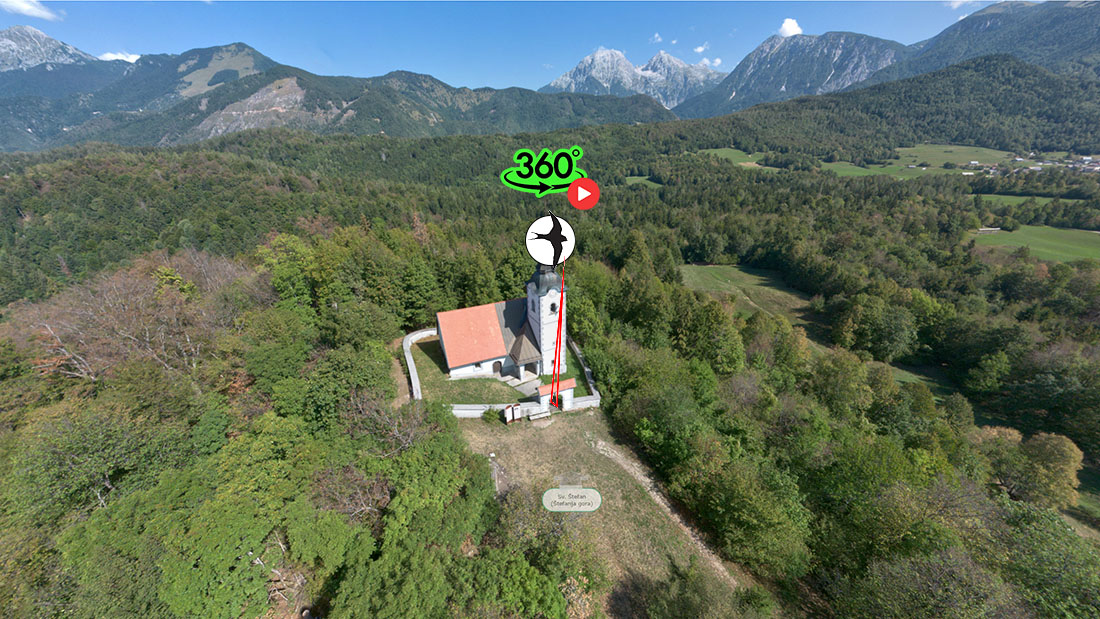
Church of St. Stephen and Architectural Development
The filial Church of St. Stephen stands atop the hill. Written sources mention the summit by this name as early as 1132, providing indirect evidence of the site's early sacred use. The original building, recorded as a chapel, is explicitly mentioned in records from 1346. In 1650, a new church was erected and consecrated four years later. A bell tower was added in 1736, housing a bell cast in the same year. In 1804, the building was struck by lightning and caught fire. Local residents restored and rebuilt it in 1805, giving the church its present spatial design, which features a rectangular nave, a semicircular presbytery, and a bell tower crowned with a Baroque spire.
Horse Breeding and Votive Traditions
Owing to widespread horse breeding across the Cerklje Plain (Cerkljansko polje), Saint Stephen became the patron saint of local breeders. Until the first half of the 20th century, a custom of offering votive figurines was maintained: horse owners crafted as many wax or wooden figures as they had animals at home, carried them in a ritual procession around the main altar, and left them there as a vow and intercession for the livestock's well-being. This custom later evolved into the annual blessing of horses, which takes place every year on December 26, the patron saint's feast day, on the flat ground below the church walls.