

Velika Nedelja Castle stands on the southeastern edge of the Slovenske gorice, at the transition between the flat Ptuj Plain and the hilly landscape stretching toward Ormož. Its position along a former Roman road and within the medieval border zone between the Holy Roman Empire and the Kingdom of Hungary gave it early strategic importance. Together with the parish church of the Holy Trinity, the castle forms a striking architectural ensemble dominating the settlement and representing its central historical landmark.
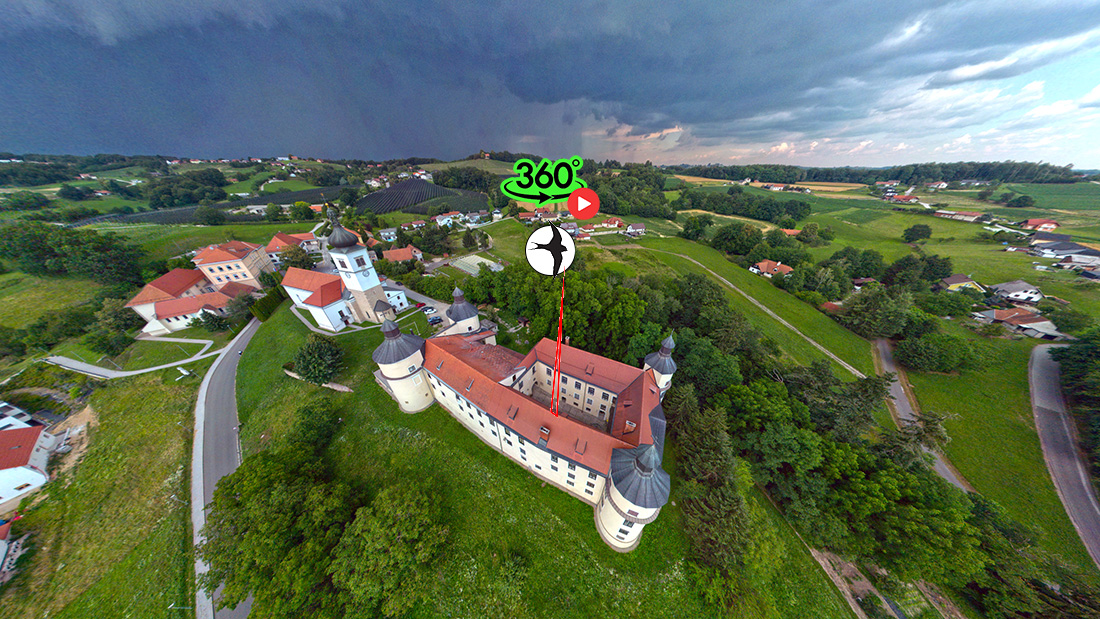
The castle was originally a commandery of the Teutonic Order. It is first explicitly mentioned in 1273, though its foundations likely date to shortly after 1200, when Frederick of Ptuj, supported by the Teutonic Knights, consolidated control over the Velika Nedelja estate. The Order established an extensive landed domain, founded the Hospital of the Virgin Mary, and built a fortified residence that served military defense, estate administration, and pastoral work. The medieval core of the castle is preserved in the southwestern section, while its overall architectural character is shaped by Renaissance design. The most significant alterations occurred between 1723 and 1730, giving the building its early Baroque appearance with an inner courtyard, Baroque well, and defensive towers. Notable artistic elements include Gothic sculptures from around 1400 and the heraldic relief of Commander Marquard von Eckh from 1612.
Adjacent to the castle stands the parish church of the Holy Trinity, built on the foundations of the former Teutonic church. The present structure is Baroque in form, yet retains earlier Gothic features, particularly in the presbytery. For centuries, the church served as the spiritual center of the commandery, reflected in its rich interior furnishings, altars, and iconography associated with the Order’s tradition. Its placement beside the castle underscores the dual function of the site: administrative‑military and sacral.
Today, the castle is managed by the Ptuj–Ormož Regional Museum. It houses an ethnological collection presenting life in Velika Nedelja through the centuries and a restored castle chapel. Together with the parish church of the Holy Trinity, it forms one of the most complete preserved early Baroque complexes in Štajerska and the core heritage ensemble of Velika Nedelja.