

Štatenberg Manor is situated at the transition between the broad plains of the Drava Plain and the first ridges of the Haloze Hills, which rise east of the Dravinja Valley into a gently rolling wine-growing landscape. Its location was far from accidental; rather, it reflects a carefully conceived Baroque approach to landscape design. The Counts of Attems chose a natural terrace overlooking the Dravinja Valley, from which sweeping views extend across the plain while the château itself is sheltered by the rising foothills. Štatenberg thus occupies a unique position between two contrasting landscape types—the open lowlands and the hilly vineyards of Haloze—giving it a distinctive spatial and visual identity.
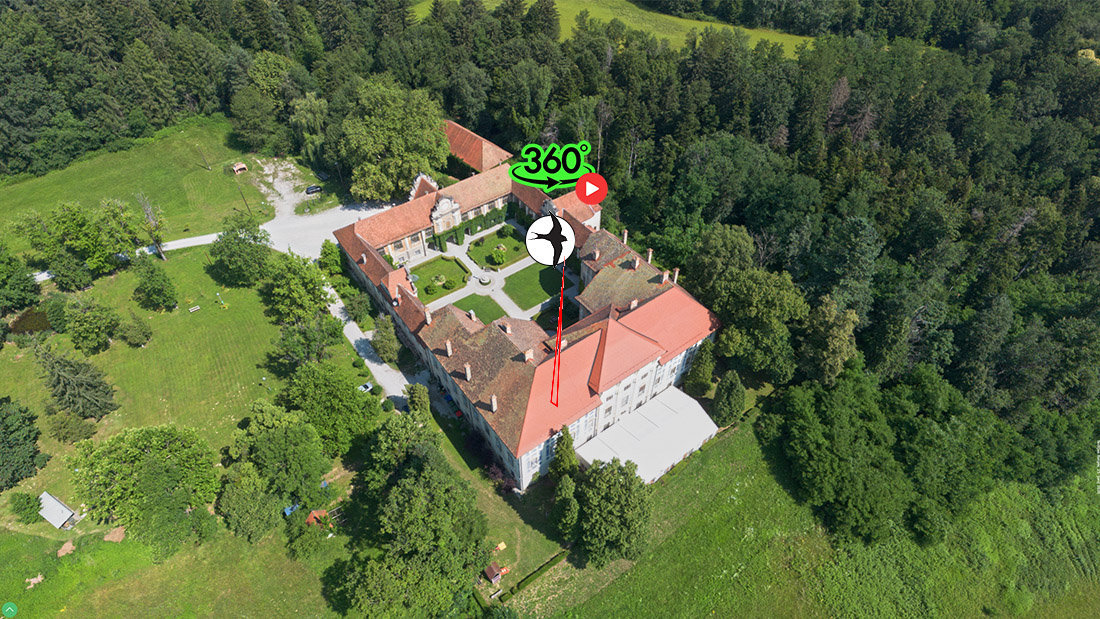
A key element of the estate's design was its ceremonial approach. A long, axial driveway, approaching the château from the northwest, gradually guided visitors towards the residence, creating a carefully staged sequence of arrival. The surrounding landscape was conceived not merely as agricultural land but as an integrated Baroque cultural landscape. Tree-lined avenues, formal gardens, fishponds, cultivated fields and service buildings formed a unified spatial composition, with the château serving as both the architectural and symbolic centre of the estate. Although the landscape has changed over time, traces of this original Baroque layout remain clearly discernible today.
The history of Štatenberg is inseparably linked with the Attems family, one of the most influential noble dynasties in Styria during the seventeenth and eighteenth centuries. As the medieval castle of Štatenberg above Makole gradually lost its residential importance, the Attems family commissioned the construction of a modern Baroque residence in the valley below. Building began around 1690 under Count Ignaz Maria Attems, while the château acquired its final appearance during the first decades of the eighteenth century. The design is commonly attributed to the Graz architect Johann Joachim Carlone, one of the leading architects of Styrian Baroque, although no definitive archival evidence confirming his authorship has survived.
The château is designed as a symmetrical four-winged complex enclosing a central courtyard, a characteristic layout of prestigious Baroque country residences. While its enclosed ground plan still reflects Renaissance traditions, the façades, axial composition and spatial organisation are unmistakably Baroque. The principal highlight is the grand ceremonial hall, richly decorated with stucco work and frescoes, which ranks among the finest examples of Baroque interior decoration in Slovenia. Numerous painted salons, historic ceramic stoves and the château chapel have also been preserved, testifying to the residence's former splendour. Allegorical frescoes depicting scenes from classical mythology and representations of the four elements reflect both the artistic taste and the cultural ambitions of its patrons.
Beyond its representative function, Štatenberg also served as the administrative and economic centre of an extensive landed estate. The property included forests, vineyards, arable fields, meadows, fishponds and numerous agricultural buildings, forming one of the most significant estates in this part of Styria. The château functioned simultaneously as the residence of the noble family, the administrative headquarters of the estate and the centre of local economic life—a dual role typical of major aristocratic estates throughout the Habsburg Monarchy.
During the nineteenth and early twentieth centuries, the château changed ownership several times, and its role gradually shifted from an aristocratic residence to an estate primarily devoted to agricultural management. In 1910, a fire damaged part of the building, including the chapel, although most of the principal state rooms survived intact. Following the Second World War, the estate was nationalised and adapted to various public uses, a period that also brought years of inadequate maintenance. Nevertheless, the château retained its essential Baroque structure, many of its historic interiors and its strong relationship with the surrounding cultural landscape.
Over recent decades, extensive conservation and restoration work has focused on preserving the building's structural integrity, restoring its roofs, ceremonial interiors, chapel and historic park. Today, Château Štatenberg is recognised as one of Slovenia's most significant Baroque country houses. It is valued not only for its architectural excellence but also as an outstanding example of the close relationship between Baroque architecture, landscape design and the cultural history of Styria.