

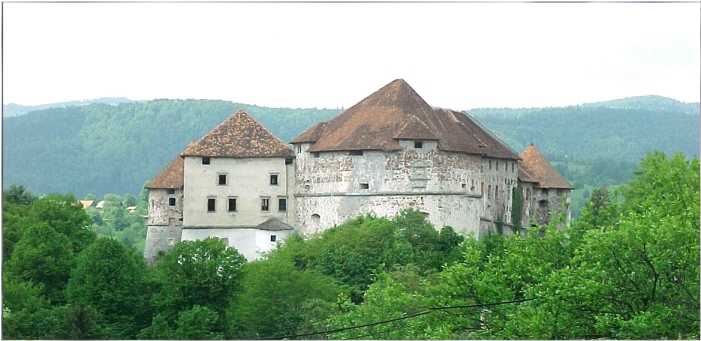
Turjak Castle: History, Might, and Cultural Heritage of the Impregnable Fortress
Turjak Castle (German: Burg Burgstall or Auersperg) is considered one of the mightiest, most strategically sophisticated, and historically significant castles in Slovenia. As the centuries-old cradle and ancestral seat of the influential noble house of the Auersperg family (knights, counts, and princes of Turjak), the castle played a decisive role in defending the land against Ottoman incursions, in the religious fervor of the Reformation, and in the birth of the Slovene literary language.
Geographic Location and Strategic Position
The castle rises on a prominent terraced rocky spur at an altitude of 512 meters, directly above the village of Turjak in the Municipality of Velike Lašče. Its location was strategically vital:
-
Route Control: It commanded a crucial transit point and trade route leading from the southern rim of the Ljubljana Marsh via Velike Lašče toward the Ribnica–Kočevje Valley, Lower Carniola, and Dry Carniola.
-
Natural Defenses: It is protected on several sides by steep, densely forested slopes, preventing attackers from mounting a swift, surprise assault.
First Mention and Origins of the Castle
The history of the castle complex dates back to the Early Middle Ages:
-
The original castle structure (the old castle or prototurn) stood slightly lower in the valley as early as the 11th or early 12th century.
-
The noble house of Auersperg is first directly documented in written records in 1220 (Konrad and Engelbert of Turjak), while Turjak Castle itself is explicitly mentioned in charters dating to 1272.
-
Following the devastating 1348 Carinthia earthquake and the great 1511 Idrija earthquake, the castle was thoroughly rebuilt and relocated to its current, strategically superior elevated site.
Architectural Strength and Defensive Impregnability
Turjak was renowned as one of the most formidable strongholds in Inner Austria, continually modernized in line with the latest developments in Renaissance military engineering:
-
Triangular Ground Plan: Connects massive residential wings, reinforced at the corners by robust defensive towers.
-
Main Defensive Roundel (Artillery Bastion): The castle's most prominent feature on the northwest side is a massive semicircular artillery tower with walls over 4 meters thick, engineered to deflect enemy cannon fire.
-
Impregnability: The fortress resisted all direct attempts at conquest. The Ottoman forces, who repeatedly raided Carniola, never succeeded in capturing Turjak. In 1515, it also withstood a fierce assault during the Pan-Slovene Peasant Revolt, which destroyed numerous other castles across the region.
Turjak Castle as a Center of Protestantism and the Creation of the Dalmatin Bible
In the 16th century, Turjak served as one of the principal spiritual and cultural hubs of the Protestant Reformation in the Slovene lands. The lords of Turjak embraced Lutheranism, establishing themselves as the leading political and financial patrons of the Reformation among the Carniolan nobility.
Safe Haven for Jurij Dalmatin
As Counter-Reformation pressures intensified across the Habsburg lands, Protestant writers and preachers lost public safety in the towns. Herbard VIII of Auersperg and his successors provided secure refuge within the castle walls for religious refugees, scholars, and writers:
-
Sanctuary for Translation: Between 1578 and 1580, Jurij Dalmatin, a pupil of Primož Trubar, retreated behind the secure walls of Turjak, where he quietly continued and completed translating the entire Holy Bible into Slovene from the original languages (Hebrew and Greek).
-
Patronage of the Family: The Auerspergs provided Dalmatin with lodging, sustenance, security, and access to the extensive castle library, in addition to generously funding the final printing of the Bible in Wittenberg in 1584.
-
Primož Trubar and the Castle Chapel: The Auerspergs also maintained close ties with Primož Trubar. A Protestant chapel operated within the castle, holding regular services in the Slovene language, and the castle housed a vast collection of Protestant literature.
Historical Development and World War II Events
Over the centuries, the castle witnessed periods of prosperity, architectural transformations, and severe trials:
-
Baroque and Neoclassical Transformations: With the end of the Ottoman threat, the fortress gradually took on a more comfortable, representative residential character featuring an arcaded courtyard, ornate halls, and a valuable archive.
-
The Battle of September 1943: Following the capitulation of Fascist Italy in September 1943, the castle became the site of a major armed confrontation:
-
Resistance Movement – Regular Anti-Fascist Slovene Army: Units of the resistance movement, organized as the regular anti-fascist Slovene army, surrounded and attacked the castle using captured heavy weaponry and artillery to neutralize the fortified enemy outpost.
-
Collaborators with Fascist Italy and Nazi Germany: Units of collaborators with Fascist Italy and Nazi Germany (members of the Village Guards and Chetniks) fortified themselves inside the castle, having collaborated with the occupying forces in the fight against the resistance movement.
-
Aftermath of the Battle: After several days of intense artillery bombardment, the castle surrendered. In the fighting, Turjak was completely burned and heavily damaged; most of its rich interior furnishings, artworks, and centuries-old castle archives were destroyed.
-
-
Post-War Restoration: Following nationalization, extensive conservation and reconstruction projects gradually restored the exterior architectural integrity of the castle, reopening it to the public.
Notable Historical Figures
Several prominent figures of Slovene and Central European history are inextricably linked to the castle:
-
Andreas von Auersperg (Andrej Turjaški, 1556–1593): Commander of the Christian light cavalry and hero of the Battle of Sisak (June 22, 1593), whose brilliant tactical charge crushed the army of Hasan Pasha Predojević. His military prowess earned him the epithet the Carniolan Achilles.
-
Herbard VIII von Auersperg (1528–1575): Provincial Governor of Carniola, Supreme Commander of the Croatian and Slavonian Military Frontier, and a major patron of Protestant literature. He fell in battle against the Ottoman forces near Budački.
-
Jurij Dalmatin (c. 1547–1589): Protestant writer and theologian who, under the shelter and patronage of the Counts of Turjak, produced the monumental first complete translation of the Bible into the Slovene language.
-
Primož Trubar (1508–1586): The pioneer of the Slovene literary language, born in nearby Rašica, who remained in constant personal and intellectual contact with the House of Auersperg.
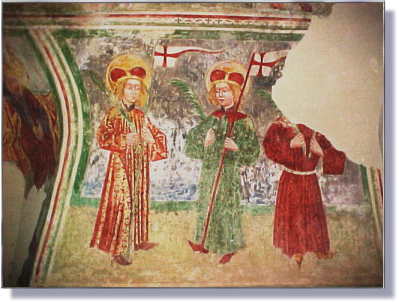
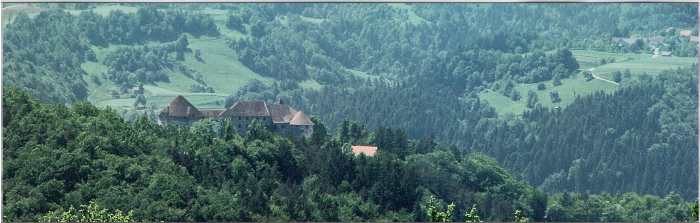
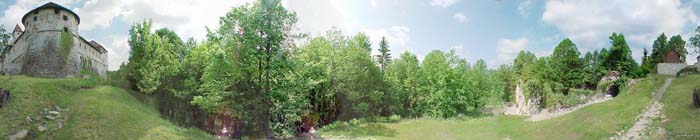 Below the castle
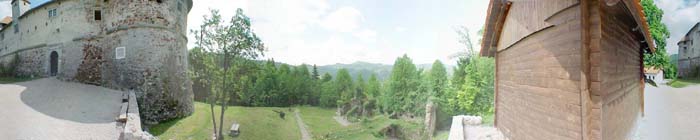 Entry to the castle
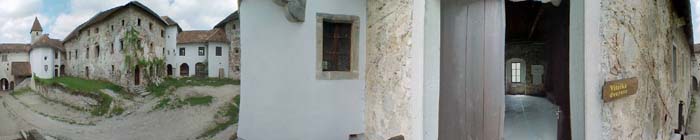 Within the walls
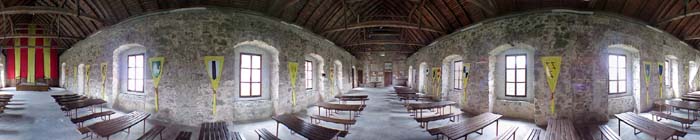 Hall of the knights