

Church of St. Pancrus stands on Grajski Grič (530 m), north of Stari Trg near Slovenj Gradec
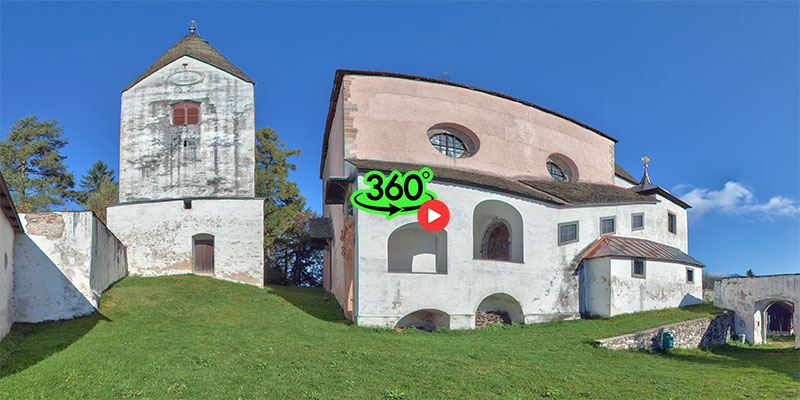
The name of the hill indicates that there used to be a castle on the hill. The castle above Stari Trg has been mentioned in historical sources since 1091 and is one of the oldest residential fortifications in Slovenia. On the site of the former fortified tower "bergfrida", today is the church bell tower, which is separate from the church. The former castle hall was converted into a castle chapel, which received its present-day church appearance during the Baroque period. During the Turkish invasions of Slovenian territory in the early 16th century, the church was fortified.
The church is characterized by the sacred stairs on the south side of the church, which complete the Way of the Cross, which ascends from the Old Church of St. Radegunde. The vault of the "sacred stairs" is richly painted with frescoes by the Baroque painter Anton Lerchinger from the second half of the 18th century.
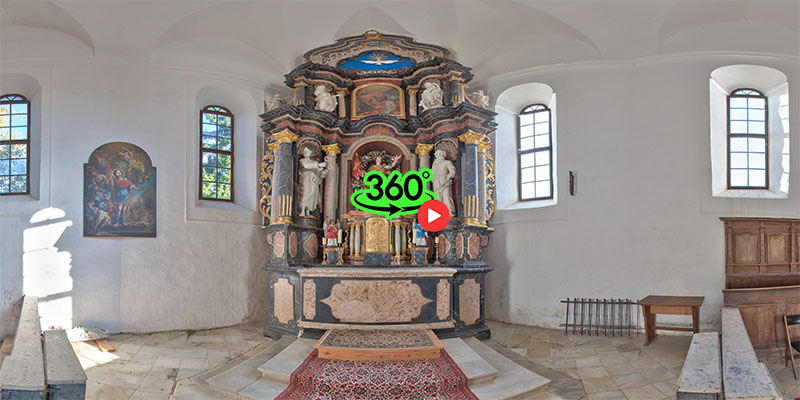
The Church of St. Pancras includes a bell tower, built independently next to the church, a nave from the second quarter of the 13th century, a presbytery and sacristy from the Baroque period in the late 17th century, and the Holy Steps from the mid-18th century as the conclusion of the Stations of the Cross. The church is architecturally designed with a centrally designed nave of the hall type with a mighty column in the middle, which may have once been the castle chapel.
The castle hill (527 m) on which the present church stands was already inhabited in the Early Iron Age, as indicated by archaeological finds from before the Celtic period. In the Neolithic Age there was a hillfort here. In Roman times, life took place at the foot of the hill. Along the Roman road Celeia-Virunum there was a post station called Colatio, and after the establishment of a new market on the site of today's Slovenj Gradec, the market settlement next to it began to be called Stari trg.
In ancient documents, a fortified settlement named Grez (Grad) was attested in this area in 1091, which gave its name to the entire valley, Greztal. The Styrian historiographer Muchar mentions a church in this area in 1090 as St. Pankratz in Graz. In 1174, when settling a dispute over feudal rights between the abbot of the Belinja monastery near Aquileia and the Savinja deacon Bertold, the ecclesia sancti Pancratii de Graz is mentioned.
From 1146, the landowners in the Mislinja Valley were the Counts of Andes. In 1180, they were given the title of Duke of Meran. In 1218, the son of the Duke of Meran, Bertold (†1251), was elected Patriarch of Aquileia. He became the sole owner of the Slovenjgraben estates, and thus the Mislinja Valley had a secular and ecclesiastical lord in one person.
The record of the visitation of Ljubljana's bishop Tomaž Hren from 31 July 1600 states that the church on Pankracijev hrib, in the middle of the walls of the old castle, is very beautifully situated, square in shape, without a presbytery, its arches supported by a marble pillar in the middle of the church. In 1681, in Vischer's copper engraving, a square church covered with a steep pyramidal roof is visible.
The independently built bell tower next to the church is an extension of the former castle tower. The bell tower has walls more than 3 m thick in the lower part. According to Ivan Stopar, the lower part of the tower is a remnant of the former bergfried. After its upper part collapsed in 1652, it was rebuilt in the form of a bell tower by 1669.
The church nave has a cubic shape, with sides of approximately 15 meters. The main entrance to the church on the west side, which was remodeled during the Baroque period, was restored to its original appearance during the restoration in 1959. The interior of the nave is finished at the top with four equally high cross vaults, supported in the middle by a mighty column made of Roman marble.
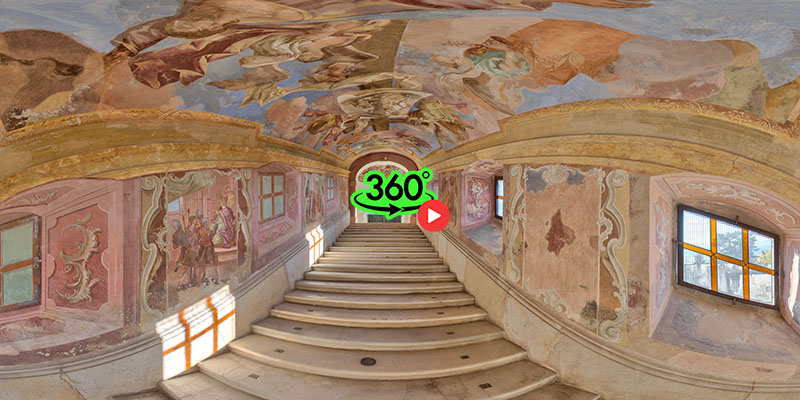
In the mid-18th century, a sacred staircase was added to the church on the south side. The frescoes on the walls depict scenes from the Passion and were painted by Jožef Anton Lerchinger around 1770. The interior of the church was renovated by the Restoration Center of the Republic of Slovenia between 1986 and 1999.
Literature and sources:
Svetlana Korelac (1999), Guide to monuments; Ivan Komelj (1966), Varstvo spomenikov; Jože Curk (1997), Mislinjsko ozemlje; Štefka Cobelj (1967), Baročni slikarji Straussi; Ivan Stopar (1977), Razvoj srednjeveške grajske arhitekture; Marijan Zadnikar (1982), Romanika v Sloveniji.