

The rock shelters along the Karst Edge of Veli Badin near Sočerga rank among the most magnificent natural landmarks in Slovenia. The primary highlight of this up to 28-meter-high sheer limestone escarpment is a series of three deep, cavernous rock shelters featuring vaulted ceilings rising up to 17 meters. Due to their acoustic properties and distinct architectural shape, locals and researchers commonly refer to them as the »Ears of Istria«. The area is legally protected as a natural monument of national importance and constitutes a vital part of the European Natura 2000 conservation network (Karst Edge area).
| Morphometric Parameter | Value / Description |
|---|---|
| Length of structural step | Approximately 2 km (from the natural bridge to St. Cyricus) |
| Cliff face height | Up to 28 m |
| Ceiling height of shelters | Up to 17 m |
| Width of central shelter | 90 m (flanking lateral shelters ~30 m wide each) |
| Dimensions of natural bridge | Arch span 6 m, height 4 m, arch thickness 1.5 m |
| Geological bedrock | Alveolina limestone (Paleogene/Eocene) overthrusted onto Eocene flysch |
| Trailhead elevation | Sočerga (250 m) – Church of St. Cyricus (405 m a.s.l.) |
In addition to the three principal caverns, numerous shallower rock shelters are distributed along the 2-kilometer-long escarpment between the natural bridge and the Church of St. Cyricus. The two flanking side shelters each measure slightly under 30 meters wide, whereas the central amphitheater spans an impressive 90 meters. The Karst Edge escarpment of Veli Badin extends in a typical Dinaric NW–SE direction, culminating at the border with Croatia in a monumental natural stone bridge. The natural bridge boasts a 6-meter-wide span, a clearance of 4 meters, and a solid rock arch thickness of 1.5 meters. Right along the border ridge, the escarpment fault line breaks and continues southward across the Istrian peninsula.
From the village of Sočerga, which serves as the ideal trailhead for hiking toward the natural bridge, it is only a 500-meter walk to the historic hilltop Church of St. Cyricus (405 m a.s.l.), situated 100 meters higher. The settlement of Sočerga rests upon impermeable Eocene flysch strata; upon ascending to St. Cyricus, the geological substrate abruptly shifts to permeable, heavily karstified Alveolina limestone. Along the brow of the Veli Badin escarpment, mechanical weathering, thermal contraction, and chemical rainwater corrosion (karst dissolution) operate with exceptional intensity. Karren, solution grooves, and sculpted limestone pavements (škraplje) are prominently exposed across the entire rim.
Beneath the thin soil horizon, the corrosive activity of percolating water is even more aggressive: boulders and bedrock outcrops of Alveolina limestone are hollowed into imaginative micro-reliefs, leaving weathered cross-sections and distinct fossil impressions of benthic foraminifera—chiefly larger alveolinids and nummulites—vividly outlined on rock faces. Along the lithological boundary at the base of the cliffs, transitions into marly limestone and flysch sandstones are clearly traceable.
Evidence of extensive historical agro-pastoral cultivation remains in the form of ancient dry-stone dividing walls (griže), which terace the slopes and consistently align toward the northeast. From the top of the cliff, panoramic vistas overlook the sweeping Movraž Valley (Movraška vala)—the largest karst polje in Slovenian Istria, framed by the compact traditional stone architecture of Movraž village.
In the far northwestern sector of Veli Badin, the escarpment features striking isolated rock pillars (tors or osamelci), produced by selective erosion along vertical tectonic joints. Geomorphologically, the Karst Edge takes the form of a stepped structural terrace; the rock shelters are situated in the upper tier, where cliff undercutting carved out deep recesses. A remarkable trait of the vaulted ceilings is their relict speleothemic morphology: calcitic flowstone, draperies, and ribs are prominently exposed, proving that these shelters are unroofed fragments of ancient underground karst caves revealed by cliff collapse and scarp retreat.
Another speleological feature lies near St. Cyricus, situated directly beneath the telecommunications mast: a more than 40-meter-long cave system reachable only with technical caving equipment—'Cave at St. Cyricus' (Jama pri sv. Kiriku). Deep below the precipice, where the road winds toward the international border crossing of Sočerga–Požane, the limestone cliffs transition into softer, rolling flysch slopes. At this impermeable geological contact, numerous freshwater springs and intermittent torrents emerge, forming the headwaters of the Bračana stream—a major right-bank tributary of the Mirna River.
Geological Samples / Geološki vzorci
(click on picture to enlarge / za povečavo kliknite na sliko)
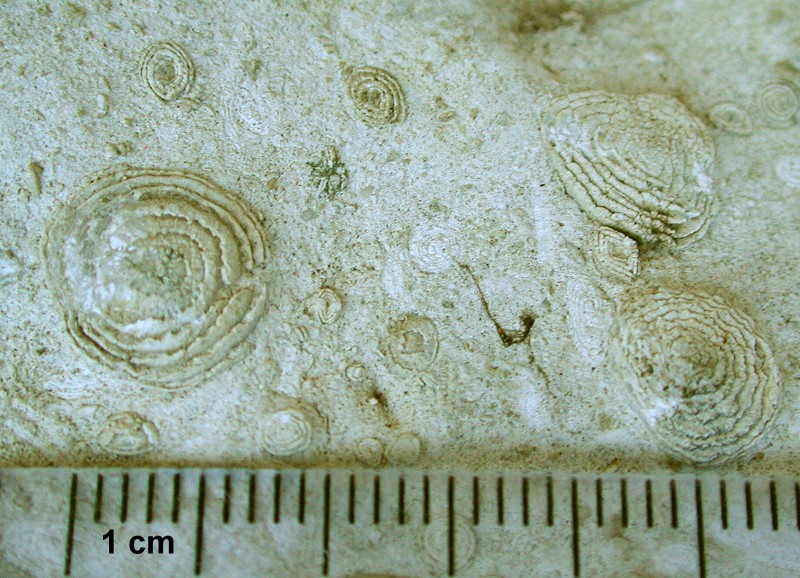
Paleocene and Eocene Alveolina fossils are differentiated primarily by size and test morphology: Paleocene forms are generally smaller and more fusiform, whereas Eocene species reach greater diameters with densely spaced septa.
Paleocenske in eocenske alveoline ločimo po tem, da so paleocenske na splošno manjše in bolj vretenaste, eocenske pa dosegajo večje premere ter imajo gostejše prekatne stene.