

The Parish Church of St. James
Introduction
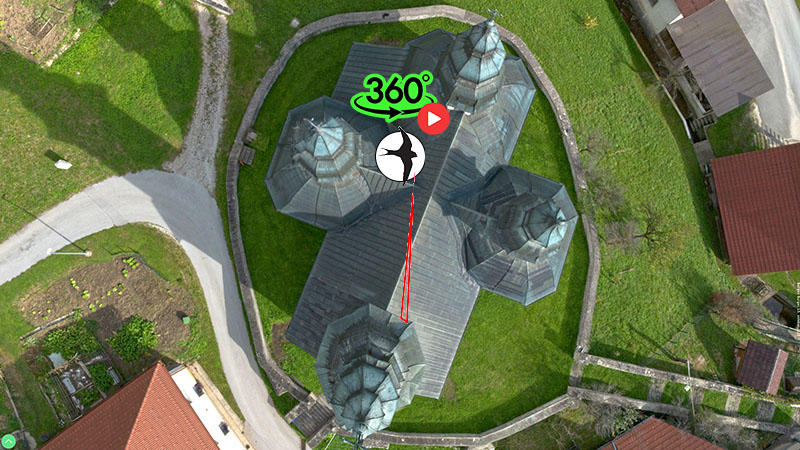
The parish church of St. James in Okonina is one of the most distinctive sacred buildings in the Upper Savinja Valley, known for its four towers that give it an almost cathedral-like silhouette. The village core formed around the church on a gravel river terrace, which explains its dominant position above the left bank of the Savinja River and its role as a spatial marker of the settlement. The church has been reshaped several times; after a fire in 1934, the community restored it in the 1980s, giving it the present form.
Historical development and pilgrimage function
Chronology and transformations
- First mention (1455): Sources point to Gothic beginnings in the 15th century, placing the church within the late medieval sacred network of the Savinja Valley.
- 18th century: The current spatial scheme emerged during renovations in the 1730s, when the church gained a notable pilgrimage function.
- Fire in 1934 and restoration: The blaze affected part of the village; reconstruction in the 1980s restored the four-tower silhouette, and the rebuilding of the roofs over the lanterned domes was completed in 1989.
Note: Local descriptions accent a “near-Byzantine” appearance, attributed to cultural memories of rafters’ contacts with eastern regions; this is an interpretive motif of communal memory rather than a strict architectural attribution.
Pilgrimage tradition
- Pilgrimage (from 1715): The establishment of pilgrimage practices to the altar of St. Ignatius of Loyola significantly shaped the church’s early 18th-century reordering and furnishings.
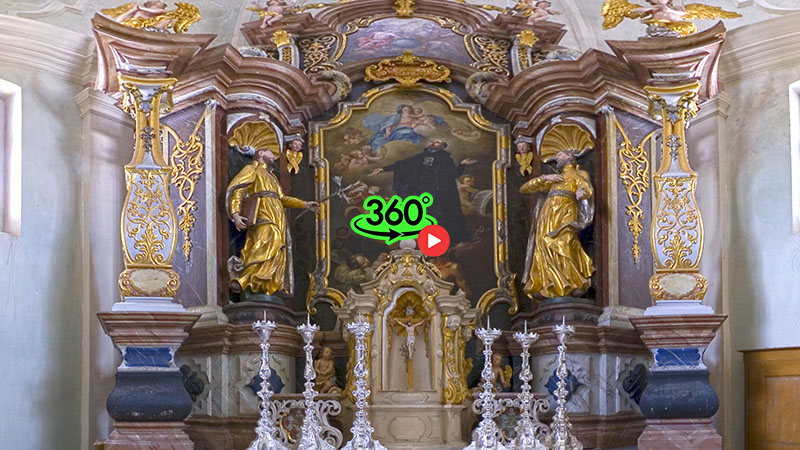
- Liturgical core: The high altar and side altars—baroque works from the early 18th century—reflect the flourishing of local workshop and patronage culture during the consolidation of post-Tridentine baroque piety.
Architectural description: four towers, nave, and analogies
Plan and volumes
- Nave and affinities: The nave plan shows kinship with the Church of St. Francis at Radmirje, suggesting the adoption of spatial solutions within a regional context.
- Four towers: The defining feature is the quartet of towers; one serves as the functional belfry, while three are positioned above altars, synthesizing verticality (towers) with the liturgical core (altar spaces).
- Typological rarity: Four towers are rare in Slovenia, frequently highlighted in local heritage presentations.
Iconography: St. James, Ignatius of Loyola, and the baroque altar program
St. James the Greater (Apostle, pilgrim)
Attributes: Broad-brimmed hat with scallop shell, pilgrim’s staff, gourd, and mantle. This iconography connects to the Camino de Santiago and the symbolism of pilgrimage. James serves as the guardian of the road and advocate of travelers.
St. Ignatius of Loyola (Jesuit founder)
Attributes: Dark Jesuit cassock, the IHS monogram, radiance, the Spiritual Exercises book, and a flaming heart. The 1715 inception of the pilgrimage to Ignatius’s altar indicates a distinct Jesuit iconographic program.
Baroque altars and side chapel niches
Altar architecture features typical combinations of faux-marble or polychromed wood with rich sculptural decoration of angels and saints. Alongside the patron and Ignatius, side altars often feature Marian cycles and protective saints like St. Roch or St. Anthony of Padua.
Art-historical significance and regional identity
The rare four-tower scheme in Okonina is functionally linked to altar spaces, exceeding mere façade representation. This synthesis grants the church a strong identity within the Upper Savinja landscape. The "Byzantine" label in local publications reinforces the silhouette’s uniqueness at the threshold of the Ljubno municipality.
Settlement and landscape context
Okonina is a clustered village above the left bank of the Savinja. The church on a gentle rise acts as an orienting landmark. The towers and lanterned domes create a vertical emphasis that reads clearly in the landscape, especially after the 1989 roof reconstruction.
Conclusion
The Church of St. James in Okonina unites a rare four-tower typology with a baroque altar program shaped by the pilgrimage practices to St. Ignatius of Loyola. Its spatial scheme and reconstruction after the fire consolidate its place in the community’s cultural memory and as a rarity within Slovenian sacred architecture.
Sources
- Municipality of Ljubno: Church of St. James in Okonina
- Savinjska – Catalogue: Sacred Monuments
- Tourist Association of Slovenia – Four towers as a rarity
- Burger.si – Panoramic documentation and descriptions