
Geographical Setting and Geomorphological Profile
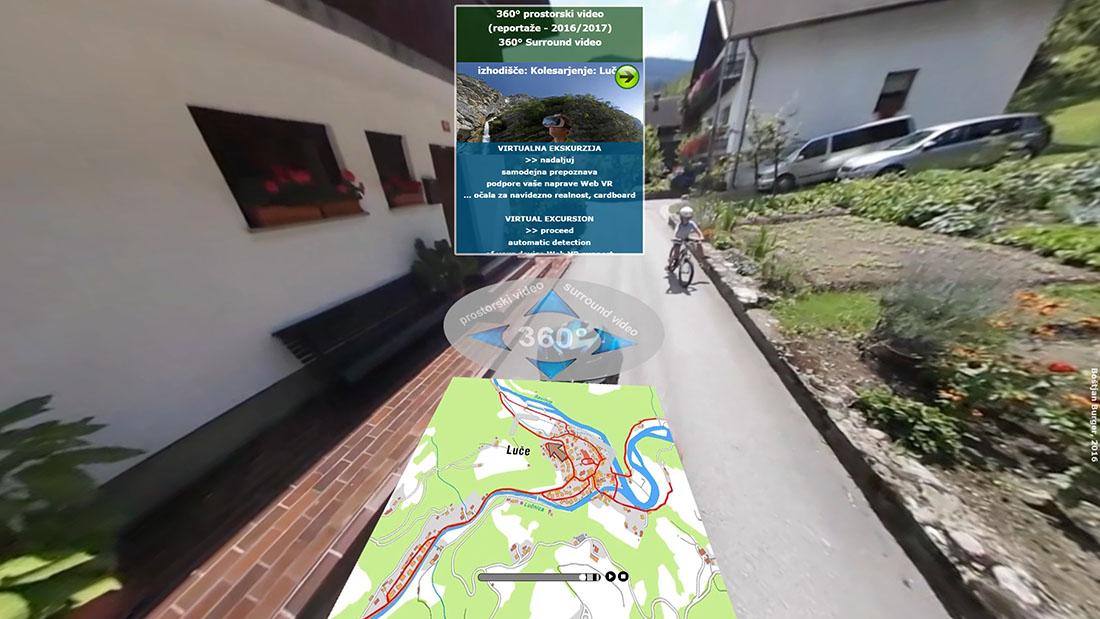
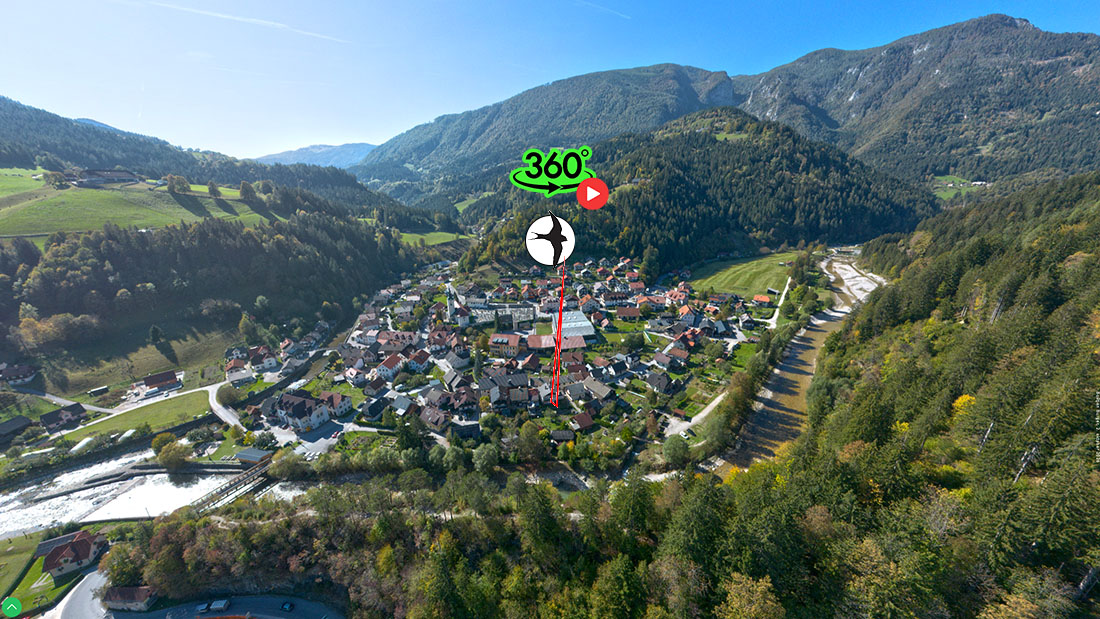
Luče is situated in an expanded valley basin along the upper course of the Savinja River at an elevation of 522 meters, directly at its confluence with the alpine torrent Lučnica. The settlement serves as the natural south-eastern gateway to the high-alpine world of the Kamnik-Savinja Alps. The valley floor is deeply incised between imposing tectonic massifs of Triassic limestones and dolomites: to the north, it is bounded by the sheer precipices of Mt. Raduha (2,062 m); to the west and north-west rises the deeply karstified Veža plateau (Dleskovec Plateau); while to the south opens the expansive alpine tributary valley of Podvolovljek, linking over high mountain passes to the sub-Alpine realm of central Slovenia.
The floor of the Luče basin is characterized by a series of prominent river gravel terraces, formed through the gradual post-glacial incision of the Savinja and Lučnica into their Pleistocene fluvioglacial deposits. The dense historic village core developed upon these elevated, dry terraces at a safe height above catastrophic torrential floods. The Savinja River is geomorphologically highly dynamic in this sector; along tectonic faults it has carved narrow gorges and ravines, while the flanking mountain slopes are marked by numerous debris cones, scree slopes, and underground karst hydrological systems. The municipality encompasses 110 square kilometers, nearly half of which falls under the Natura 2000 ecological protection regime, testifying to the exceptional preservation of its primeval forest habitats, pure alpine waters, and high-mountain ecosystems.
History: From Prehistoric Traces to the Modern Era
The earliest traces of human presence in the wider region date back to the Paleolithic. High-altitude cave sites, most notably Potočka zijalka on Mt. Olševa as well as smaller cavern shelters in the rocky walls of Raduha, served as seasonal hunting posts for Ice Age cave bear hunters.
The medieval development and colonization of Luče were inextricably linked to the founding of the Benedictine Monastery in Gornji Grad in 1140. The territory along the Savinja and its tributaries fell under monastic lordship, with the monks directing systematic forest clearing and high-elevation agricultural settlement. Luče is first explicitly mentioned in written records in the Gornji Grad monastic land register (urbar) of 1426, while the parish church of St. Lawrence was documented as early as 1423. Following the dissolution of the Benedictine monastery in 1473, the estates were transferred to the newly established Diocese of Ljubljana, making the inhabitants of Luče episcopal subjects. One of their primary in-kind feudal dues was the regular provision of fresh Savinja river trout for the bishop's court.
Linguistic analysis connects the name of the settlement to the Latin word lucus (a sacred grove or forest clearing), reflecting early clearings for settlement, while local lore traces it to mystical glowing lights and the legendary alpine forest maidens (žalik žene), who aided herdsmen in their daily toil. This synthesis of historical reality and myth is immortalized in the municipal coat of arms: it portrays a maiden holding a lit lantern, carrying on her back a wooden wicker basket (brenta) from which the tail of a Savinja trout emerges.
The spiritual center of the village is the parish church of St. Lawrence, originally a Gothic sanctuary that underwent extensive Baroque transformation throughout the 17th and 18th centuries. It features ornate Baroque altars, intricate stonework, and rich liturgical furnishings. Around the church, an architectural ensemble evolved, defined by characteristic market-town houses with whitewashed masonry ground floors and timber-framed upper stories.
Population, Settlement Pattern, and Vernacular Architecture (Celki)
The Municipality of Luče encompasses seven settlements (Luče, Krnica, Podveža, Podvolovljek, Raduha, Strmec, and Konjski Vrh) and counts approximately 1,400 inhabitants, of whom around 400 reside in the central village core of Luče. The entire area is characterized by a low population density and an isolated mountain settlement pattern of solitary farms—the so-called celki. These extensive estates consist of unified landholdings where the farmhouse, outbuildings, arable fields, meadows, and adjacent mountain forests form an integrated whole. Many of these homesteads are located at elevations between 900 and well over 1,200 meters above sea level (especially across the slopes of Raduha and Rogatec), ranking among the highest permanently inhabited homesteads in Slovenia.
These mountain farms represent exquisite monuments of alpine vernacular architecture:
-
Farmhouses: Imposing structures built with thick stone-walled basements and ground floors, topped by solid log-timber upper levels, traditionally covered with indigenous wooden shingle roofing (špičaki).
-
Outbuildings (Barns with Threshing Floors): Multi-story agricultural edifices designed for hay storage and livestock stabling, engineered into steep slopes with heavy timber vehicular bridge ramps leading directly into the upper threshing floor.
-
Granaries (Kašče): Freestanding timber or masonry storehouses adorned with carved portals and wrought-iron locks, deliberately erected apart from the primary farmhouse for fire safety, safeguarding harvested grain, spun linen, and valuable farm produce.
The survival and rhythm of the celki have always been bound to seasonal high-alpine pastoralism. From late spring to early autumn, livestock is driven up to the expansive karst plateaus and pastures beneath the peaks of the Kamnik-Savinja Alps: to Ravne, Podvežak, Molička planina, Vodotočnik, and Korošica. Centuries of traditional grazing have shaped an open parkland of alpine meadows dotted with European larches and sustained ancestral culinary craftsmanship. Local specialties include lučki masunek (rich cooked cream thickened with buckwheat or corn flour) and the geographically protected Upper Savinja stomach (zgornjesavinjski želodec), an air-dried cured meat delicacy cured exclusively by dry alpine breezes according to traditional recipes.
Modern Economy, Employment, and Education
The local economy has evolved from traditional subsistence based on wood and water to modern services, manufacturing, and sustainable agriculture. Its historical pillars were forestry, charcoal burning, freight hauling (furmanstvo), sawmilling, and timber rafting (flosarstvo—floating Savinja timber downstream all the way to the Danube).
Today, the economic pulse of Luče is defined by:
-
Local Enterprise and Craftsmanship: The municipality hosts several successful enterprises specializing in plastics processing, toolmaking, and metalworks, complemented by traditional trades (carpentry, timber processing, construction, and haulage) that secure an important share of local jobs.
-
Daily Commuting: A significant portion of the working population commutes daily to industrial and service centers lower down the valley (Nazarje, Ljubno, Mozirje), the Šalek Valley, and Celje, while a smaller share travels over the passes toward central Slovenia (Kamnik, Ljubljana).
-
Education: The local community is anchored by the autonomous nine-year Blaž Arnič Primary School with an integrated kindergarten unit. Secondary school students commute daily to educational centers in Velenje, Celje, or Kamnik.
Community Life, Culture, and Traditions
The cultural and social life of Luče is underpinned by a close-knit community and a rich heritage:
-
Musical and Cultural Heritage: The village takes deep pride in composer Blaž Arnič (1901–1970), born beneath Mt. Raduha, after whom the local school is named. Active cultural associations, vocal groups, and a folklore troupe maintain vibrant cultural programming throughout the year.
-
Events and Customs: The annual highlight is Lučki dnevi (Luče Days), featuring ethnological demonstrations of traditional alpine crafts (carpentry, water-powered Venetian sawmilling, logging techniques) and local culinary specialties. Rafters' traditions and parish feasts also remain actively celebrated.
-
Volunteerism: Fundamental pillars of safety and civic life are the Luče Volunteer Fire Department, with a legacy spanning more than a century, and the Mountain Rescue Service (Luče Station), which plays a vital role across the demanding high-altitude terrain of the Kamnik-Savinja Alps.
The Podvolovljek Valley and the Lučka Bela Gorge
The Podvolovljek Valley is one of the most pristine alpine valleys in the Savinja river basin. It stretches south from Luče along the course of the Lučnica stream for approximately eleven kilometers. To the east, the valley is bordered by the rugged mountain chain of Veliki Rogatec (Rogač, 1,557 m) and Lepenatka (1,425 m), while to the west it is framed by the forested slopes and sheer escarpments of the Dleskovec Plateau.
The settlement of Podvolovljek has no nucleated center; it consists of solitary high-altitude farms scattered along sunlit terraces and along the valley floor. Near the head of the valley, the terrain ascends toward the Kranjski Rak pass (1,029 m) and the nearby Črnivec pass (902 m), which have marked the historical boundary between Styria and Carniola for nearly a millennium. Podvolovljek accommodates an important mountain transit artery toward Kamnik and central Slovenia, serving as a primary mountaineering trailhead for Velika planina, Kašna planina, Rogatec, and high routes leading toward Korošica and Mt. Ojstrica.
In the upper reach of Podvolovljek, the valley of Lučka Bela branches westward—a wild, uninhabited glacial canyon pressed beneath the soaring vertical limestone walls of Veža and Vršiči. Because of its virgin beech-fir and larch stands and its vital role as a sanctuary for rare alpine birds and raptors, the entire valley is protected as a strict forest reserve and natural monument.
Natural Monuments and Hydrological Phenomena
The Municipality of Luče boasts a wealth of unique geomorphological and hydrological landmarks:
-
Snow Cave on Mt. Raduha (Snežna jama): Located on the southern slopes of Raduha at the Arto alpine pasture (1,556 m), this is the highest-altitude show cave in Slovenia. Estimated to be between 10 and 12 million years old, its entrance sections display permanent subterranean ice sheets, colossal ice pillars, and frozen cascades, while its deep interior reveals delicate deposits of moonmilk (montmilh), cave pearls, and majestic flowstone formations. Guided tours illuminated solely by traditional carbide lamps preserve an authentic speleological exploration experience.
-
The Gorge and the Needle (Igla): Roughly two kilometers north of Luče toward Solčava, the Savinja Valley contracts into a narrow limestone gorge. Standing detached within it is Igla—an approximately 40-meter-tall limestone needle separated from the main rock wall by a vertical cleft only two meters wide. Prior to the construction of the modern road at the close of the 19th century, the only pedestrian path between Luče and Solčava was chiseled through this narrow gap.
-
The Intermittent Spring by the Needle: Situated at the very base of the Needle rock pillar, this hydrological monument periodically discharges groundwater in rhythmic pulses: water wells up, fills the source basin, and subsequently recedes to complete dryness. This mechanism is operated by a natural underground siphon network draining the karstified interior of the Dleskovec Plateau.
-
Cuc Waterfall in Podvolovljek: A picturesque multi-tiered mountain waterfall situated in the rugged gorge of the Suha stream (a right-hand tributary of the Lučnica), plunging across steep rock tiers with a total height of approximately 60 meters.
-
Lake Vodotočnik: A high-mountain karst tarn famously shaped like a heart, resting upon the Dleskovec Plateau at an altitude of 1,805 meters beneath the peaks of Vežica and Ojstrica. Its waters are perched on an impermeable clay substrate amid heavily karstified high-altitude terrain.
Sustainable Tourism and the International "Mountaineering Villages" Network
Today, Luče is an integral member of the international network of Mountaineering Villages (Bergsteigerdörfer). Initiated under the framework of the Alpine Convention, this designation unites alpine communities committed to nature conservation, cultural landscapes, and quiet mountain tourism free from mass commercialization and oversized infrastructure.
Recreational pursuits center on authentic contact with alpine nature:
-
Mountaineering and Climbing: Luče is a primary gateway for ascents of Raduha, Ojstrica, the Dleskovec Plateau, Rogatec, and Lepenatka, as well as routes to alpine refuges (Koča na Loki, the refuge on Planina Vodotočnik, and Kocbekov dom na Korošici).
-
Angling and the Savinja River: The Savinja and Lučnica form a renowned sports fly-fishing district (grayling, brown trout) managed by the Ljubno ob Savinji Fishing Club under a strict catch-and-release regime. Following the devastating floods of August 2023, which reshaped the riverbeds and affected aquatic life, ongoing natural restoration and habitat revitalization continue along the river corridor.
-
Winter Sports and Mountain Biking: In snowy months, the surrounding mountains provide ski-touring itineraries and cross-country trails, while from spring to autumn, designated mountain biking routes connect Luče with high alpine pastures and neighboring Solčava.