

| Location Name | Menina planina |
| Region | Kamnik-Savinja Alps |
| Altitude | 1300 ~ 1500 m / 4265 ~ 4921 ft |
| Highest Peak | Vivodnik (1,508 m / 4,947 ft) |
| Features | Subalpine karst plateau, "lokve" ponds |
| Status | Biba Lake is a natural monument |
Menina Plateau is one of those Slovenian high plateaus that does not reveal itself through dramatic peaks, but through the generosity of space. With its elevation between roughly 1300 and 1500 meters and its broad, undulating ridge, it forms a transition between the Alpine and pre-Alpine worlds, between the sharpness of the Kamnik–Savinja Alps and the gentler hills of central Slovenia. Its position is distinctly transitional: to the south the plateau descends toward the Tuhinj Valley, while to the north it opens toward the Dreta Valley and the town of Gornji Grad.
The summit area of Menina Plateau is surprisingly wide: about 3 kilometres in the north–south direction and 7 kilometres east–west. This expanse creates a sense of openness that is rare in the Slovenian mountains. The plateau is varied, interwoven with smaller peaks such as Vivodnik, Oseka, and Biba, as well as numerous sinkholes, collapse dolines, and karst depressions that reveal its geological story.
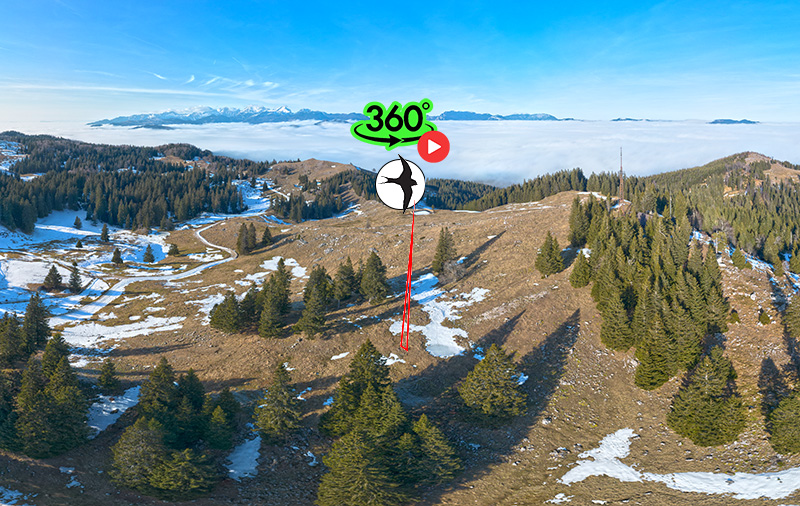
Menina Plateau is a karst landscape, which is unusual in the pre-Alpine region. Its bedrock consists mainly of limestone and dolomite, which over millennia have dissolved, fractured, and collapsed. This has created a typical high-mountain karst terrain: sinkholes, shafts, dry valleys, and occasional springs that appear only after heavy rainfall. The subterranean world of Menina is less explored than that of the Classical Karst, but precisely because of this it retains a sense of primal mystery.
The karst nature of the plateau has also shaped its water regime. Surface streams are almost nonexistent; water quickly disappears underground, which forced shepherds and travellers through the centuries to search for or construct water collectors, ponds, and watering places. This interplay between rock and water has shaped the vegetation as well: grasslands, dwarf pine, spruce forests, and extensive alpine meadows that today form one of Menina’s most recognizable features.
The name Menina is no coincidence. Part of the plateau once belonged to the Benedictine monks of Gornji Grad, one of the oldest and most influential monasteries in Slovenia. The monks used the plateau as pasture and forest land, which influenced land use, the development of paths, and the formation of the cultural landscape.
Today Menina Plateau is a space where tradition, nature, and modern visitation intertwine. Pastoralism is still present, though on a smaller scale than in the past. Alpine dairies and grazing areas preserve the cultural landscape, which would quickly become overgrown without human presence.
The highest rising of the plateau is Vivodnik (1,508 m n.v.). A distinct feature of the area are the numerous small ponds named "lokve". Another notable landmark is the unusually shallow Biba jezero (lake), which is protected as a natural monument.