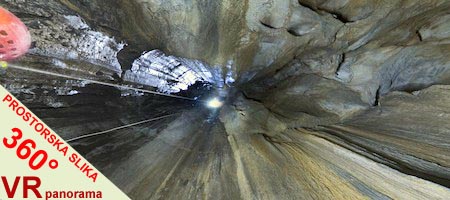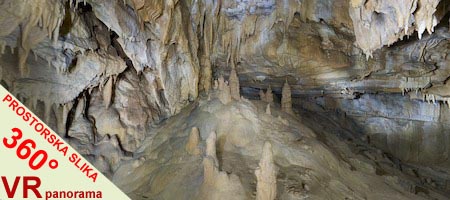

Logaška jama, hidden in the forested landscape northeast of Logatec, lies at an elevation of 521 meters, precisely at 45.93118° N and 14.25931° E. It is located 2.7 kilometers in a straight line—or 3.4 kilometers along forest paths—from the center of Logatec. Its entrance is a roughly 30‑meter‑deep shaft with a narrow opening that widens into a bell‑shaped chamber below. Even the first glance into the darkness reveals that Logaška jama is a space shaped slowly and persistently by nature, a place where the underground world begins abruptly and dramatically.
The total length of the cave passages is about 450 meters, placing the cave among the smaller yet highly intriguing karst features of the Logatec region. Because of its distinctly vertical character, the cave is accessible only with proper caving rope techniques, which means that entry is generally limited to experienced cavers. Nevertheless, the Logatec Caving Society has for decades maintained the tradition of organized visits, during which they install a manual winch above the entrance and safely lower visitors into the cave. This tradition has become an important part of local identity and a rare example of how a technically demanding cave can still be shared with the broader public.
Logaška jama was discovered in 1962, and the first documented descent took place in 1974. At a time when caving in Slovenia was rapidly developing, the cave quickly became a training ground for generations of cavers who practiced rope techniques, rescue procedures, and navigation in narrow underground spaces. Its history is closely tied to the growth of caving in Logatec, which has long been recognized as one of the centers of Slovenian speleology.
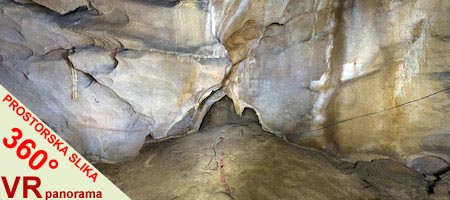
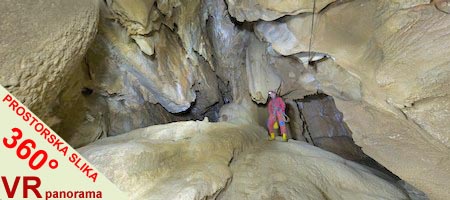
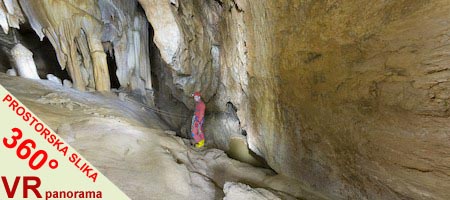
Geomorphologically, Logaška jama is a typical example of a vertical karst system formed through ceiling collapse and the gradual deepening of fractures in limestone. The bell‑shaped entrance shaft leads into a series of smaller chambers and passages that interconnect into a compact cave system. The walls reveal traces of ancient water flow, smooth surfaces polished by millennia of erosion, and sharp fractures that speak of the tectonic forces shaping the region. Although the cave is not rich in speleothems, small stalactites, thin tubes, and delicate draperies appear in several places, testifying to the slow but continuous formation of cave decorations.
One of the cave’s defining qualities is its pristine character. Because it is not developed for tourism and access is limited, Logaška jama has preserved a raw naturalness that has been lost in many more frequently visited caves. This authenticity is one of the main reasons why the cave remains popular among cavers, who see it as a place for learning, exploration, and direct contact with nature in its most unrefined form. Over the decades, it has hosted numerous training sessions, rescue drills, and research expeditions that have shaped the caving community of Logatec and the wider Notranjska region.
In 2009, I documented Logaška jama as part of a project dedicated to visualizing significant geographical and cultural landmarks of Logatec. The entire mini‑expedition lasted six hours and was carried out with the assistance of a member of the Logatec Caving Society, who provided technical support during the descent and movement through the cave. Despite the relatively short timeframe, the task was demanding: it required descending into the cave, setting up equipment, illuminating individual spaces, and capturing visual material that would faithfully represent the cave’s character. The documentation formed part of a broader effort to present Logatec through its natural and cultural features, with Logaška jama serving as one of the key subterranean elements.
Beyond its natural and exploratory significance, the cave also has educational value. Due to its accessibility and modest length, it is well suited for demonstrating basic karst processes, geomorphology, and cave ecology. Schools, associations, and research groups often include it in their programs, as it offers a safe yet authentic insight into the karst underground. Within its passages, one can observe various stages of cave formation—from initial fractures to larger chambers—giving the cave a didactic value that exceeds its size.
Although Logaška jama is not a water cave, it plays an important hydrological role. Its position on the edge of the Logatec karst field means that it forms part of a broader network of underground water pathways that shape the hydrology of Notranjska. During periods of heavy rainfall, the level of groundwater rises, influencing the cave’s microclimate and internal dynamics. Such changes provide valuable information for researchers studying the effects of climate variability on karst systems.
The cave is also a compelling subject for underground photography. Its contrasts between narrow passages and wider chambers challenge photographers who seek to capture the interplay of light and shadow in a natural environment. Although it does not offer grand speleothem halls, Logaška jama has a distinctive character that can be captured only with a deep understanding of space and underground illumination.
All these layers—natural, historical, social, exploratory, and documentary—shape Logaška jama into a space that transcends its modest length. It is a place where nature, knowledge, and community intersect. A place that must be approached with respect, for it reveals a world largely hidden from view. Every descent into the cave is a reminder of the richness of Slovenia’s underground landscapes and the importance of preserving karst heritage for future generations. Logaška jama remains a silent yet powerful witness to the natural processes that shaped Notranjska and a symbol of the caving tradition deeply rooted in Logatec.