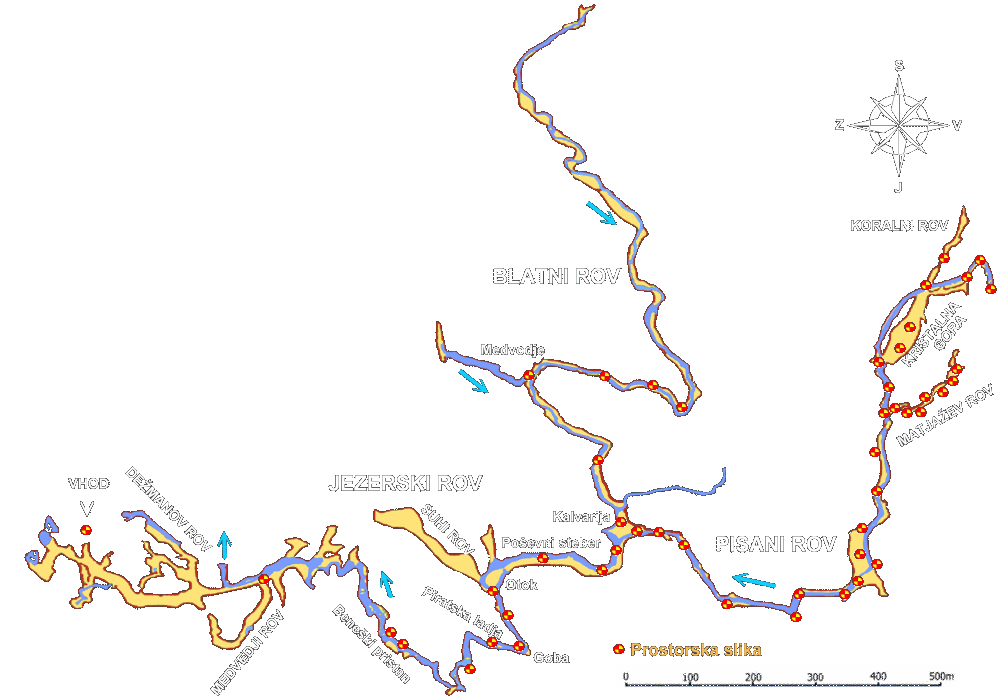

Križna Cave (Križna jama), an 8,273-meter-long karst cave system situated beneath the plateau triangle between Bloke, the Lož Valley, and Cerknica Polje, is renowned as one of the most pristine and valuable natural treasures in Slovenia. The entrance to this subterranean world lies approximately 1.5 kilometers south of Bloška Polica. Over the centuries, it has attracted inquisitive visitors, naturalists, and later generations of speleologists, who recognized it as an exceptional natural laboratory. Named after the nearby Church of the Holy Cross on Mount Križna Gora, the cave's defining signature is an emerald-hued chain of subterranean lakes separated by travertine and rimstone dams (gours), shimmering like a series of crystal mirrors in the quiet depths.
In terms of subterranean biodiversity, Križna Cave ranks as the fourth richest cave ecosystem in the world. Its passages harbor around 60 obligate cave-dwelling (troglobiotic and stygobiotic) species, including numerous tiny endemics such as cave amphipods, subterranean snails, and cave beetles. The cave was first documented in 1832, although wall inscriptions—most notably one dating back to 1567—prove that intrepid explorers ventured inside centuries earlier. A pivotal milestone occurred in 1926, when Slovenian cavers systematically explored the aquatic section, traversing the initial lakes and rimstone barriers in small inflatable boats.
One of Europe's Richest Cave Bear Paleontological Sites
A distinguished chapter in Križna Cave's legacy is its paleontological heritage. The cave represents one of the most important and abundant fossil sites of the extinct cave bear (Ursus spelaeus) in this sector of Europe.
-
History of Discovery and Excavations: The first fossilized bones were noted in 1847 by Aleksander Skofiz. A major scientific breakthrough came in 1878 through Viennese geologist and paleontologist Ferdinand von Hochstetter. In only a few days of excavation within the cave sediments of the entrance zone and the so-called Bear Passage (Medvedji rov), Hochstetter and his team unearthed more than 2,000 bones. From this assemblage, two complete skeletons were assembled in Vienna, where they remain on display at the Natural History Museum Vienna (Naturhistorisches Museum Wien). The largest excavated skulls measure up to 56 centimeters in length, with specimen ages estimated between 45,000 and well over 100,000 years. Representative bones and an authentic skull remain preserved on site for visitors inside the passage.
-
Why Did So Many Skeletons Accumulate Here? The vast accumulation of bones was not deposited by subterranean flood currents transporting carcasses from afar, but was the natural outcome of the animals' annual life cycle:
An Ideal Hibernation Den: Cave bears were massive, predominantly herbivorous Ice Age mammals that sought caves not merely for temporary shelter, but as primary overwintering dens. Križna Cave provided a secure environment with spacious, dry entrance chambers, a stable year-round temperature (around 8 °C), and protection from harsh winter elements.
Millennia of Consecutive Use: Cave bears utilized the cave as a winter refuge across tens of thousands of consecutive years, with generation after generation returning to the identical passages.
Natural Mortality During Dormancy: Despite accumulating thick layers of subcutaneous fat, many individuals did not survive the prolonged winter fast. Mortality disproportionately affected aged bears with worn dentition, diseased animals, and juvenile cubs during their first winter.
Exceptional Taphonomic Conditions: Persistent high humidity, constant temperatures, and total absence of solar radiation preserved the skeletal material intact within cave clays for millennia, with numerous remains further encapsulated beneath protective layers of calcite flowstone.
Within Bear Passage, visitors can still observe authentic bear wallows and nests (rounded sleeping hollows excavated in clay) as well as bear polishes—smooth, burnished rock walls where these Ice Age giants repeatedly rubbed their fur upon awakening from hibernation.
This remarkable environment served as the backdrop for a comprehensive documentation and visualization project of Križna Cave, initiated in 1999 and brought to completion in December 2013 with the visualization of Muddy Passage (Blatni rov). Fourteen years of phased expeditions represented not only an intricate logistical and technological challenge, but also demanded tremendous physical and mental endurance. Fieldwork was conducted primarily during winter months when subterranean humidity drops and ambient air transparency is highest, crucial for crisp optical clarity and equipment reliability. Winter also minimized the thermal differential between the surface and the cave interior, mitigating lens and electronic condensation. Expeditions routinely lasted up to 19 continuous hours underground without surfacing.
A vital milestone of the project was the continuous evolution of cavern illumination. In the foundational years, scenes were illuminated by metal-halide lamps delivering intense, cool-toned light across vast chambers and lengthy passages. However, these systems required heavy lead-acid batteries that cavers had to manually haul through challenging muddy crawls and across lakes. Over time, advancements in high-output LED emitters and lightweight lithium-ion cells enabled agile, portable setups with refined beam control and extended runtime.
The light-painting methodology—a technique employing long camera exposures while moving directional light sources dynamically across the cavern—served as the cornerstone of the project. In monumental spaces such as Crystal Mountain (Kristalna gora), the largest hall in the cave, light had to be deliberately sculpted across sheer walls, ceiling domes, and floor boulders to reveal the chamber's immense scale and rich mineral textures.
The documentation covered the entire cave system, extending from the entrance portals to the remotest reaches. Capturing Muddy Passage, the challenging northern branch characterized by deep, adhesive clay and tight squeezes, proved especially arduous. Its successful visualization in December 2013 marked the formal conclusion of the 14-year endeavor.
Today, Križna Cave stands preserved not only as an internationally protected natural monument, but also as a digital heritage archive. This comprehensive virtual exploration offers universal access to chambers otherwise restricted to specialized cavers under rigorous conservation protocols.