

Žužemberk Castle (Grad Žužemberk) is one of the most imposing, historically rich, and visually striking medieval castles in Slovenia. Perched on a steep rocky promontory directly above the Krka River in the heart of Suha krajina, its naturally fortified and commanding position allowed it to control a vital river crossing, a navigable waterway, as well as trade and military routes between central Slovenia, Lower Carniola (Dolenjska), and White Carniola (Bela krajina) for centuries.
The fortification is first reliably mentioned in historical records in 1295 as Seisenberg (also recorded as Sosenberch, Seussenberg, or Seyßenberg). The name derives from the German term for "dry mountain" or "dry hill," directly describing the typical karst, waterless landscape of Suha krajina (literally "Dry Carniola"). The modern Slovenian name Žužemberk gradually evolved from this German root.
Historical Development and Noble Ownership
The castle's origins date back to the 13th century (with some historical accounts and traditions pointing to around the year 1000). Early lords included vassals of the Counts of Gorizia, the Patriarchs of Aquileia, and the Knights of Seisenberg. Following the extinction of the Istrian branch of the Counts of Gorizia in 1374, the castle fell to the Counts of Celje, and after their extinction in 1456, it passed into Habsburg hands as princely domain.
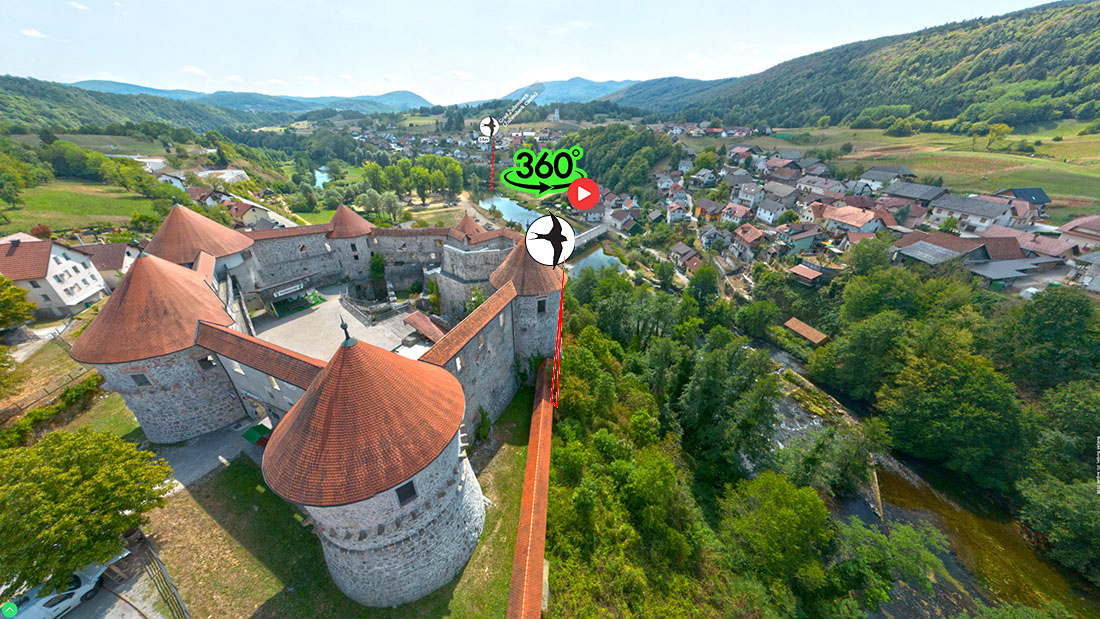
A pivotal turning point occurred in 1538, when the brothers Wolf Engelbert and Jurij (Georg) of Turjak (Auersperg) purchased the estate from Emperor Ferdinand I. The Auersperg dynasty held the property for more than four centuries, up until the end of World War II. During the 16th century, faced with the constant threat of Ottoman incursions, the Auerspergs thoroughly transformed the castle into a formidable Renaissance fortress: surrounding it with massive defensive walls, embrasures, and six monumental round defensive bastions protecting access from the town square.
Notable Historical Figures Associated with the Castle
Prominent historical figures are closely tied to Žužemberk Castle and the House of Auersperg:
-
Andrej Turjaški (Andreas von Auersperg, 1557–1594): One of the most celebrated military commanders of his era, famously dubbed the Carniola Achilles. He served as one of the key leaders of the Christian forces in the decisive Battle of Sisak in 1593, where they decisively defeated the Ottoman army led by Telli Hasan Pasha.
-
Janez Vajkard I. Turjaški (Johann Weikhard von Auersperg, 1615–1677): Born at Žužemberk, he rose to become the first minister and privy councillor at the Habsburg imperial court, attaining the rank of Prince of the Holy Roman Empire. In 1669, he established an inalienable family entail (fideicommissum) for the Žužemberk estate.
-
Wolf Engelbert Auersperg (1610–1673): Also born at Žužemberk, he was an influential Provincial Governor (Landeshauptmann) of Carniola, a patron of the arts, and a military commander.
-
Anna von Eck (wife of Ivan Turjaški / Hans von Auersperg): Tied to one of the most tragic legends of the castle. In 1575, she was fatally mauled in the castle courtyard by a domesticated castle bear. A linden tree was planted in the center of the courtyard in her memory, enduring for more than 400 years (until 1999).
Decline in the 19th and 20th Centuries
At the end of the 18th century, when the princely branch of the Auerspergs relocated to the more comfortable nearby manor of Soteska, the castle gradually lost its residential purpose. Through the end of the 19th century, it housed a district court, prison cells, a tax office, and a school; after these moved out, the complex fell into rapid decay.
The castle suffered its final and most devastating blow during World War II. Because it served as a heavily fortified stronghold for German and Home Guard (Domobranci) forces, Allied aircraft heavily bombarded it in February 1945. The castle was largely ruined and gutted by fire, and a few years after the war, part of the main tower collapsed, reducing the stronghold to an extensive ruin.
Systematic Restoration in Recent Decades
Initial conservation efforts began in the late 1960s (1969) under the architectural and conservation plans of Ivan Komelj and Vlasto Kopač, who stabilized and roofed the most accessible towers, though work came to a halt after 1978 for nearly two decades.
The major breakthrough occurred in 1997 with the establishment of the independent Municipality of Žužemberk and the formation of a dedicated Castle Restoration Committee:
-
Conservation Doctrine: An approach was adopted to fully reconstruct the external Renaissance perimeter, bastions, and curtain walls, while consolidating and presenting the interior medieval core and residential wings as a picturesque, readable ruin showcasing its building phases.
-
Intensive Structural Rehabilitation (1997–2015): The exterior walls were stabilized, all defensive towers were structurally secured and roofed, the former castle wine cellar was restored, and the main courtyard was paved and equipped with an event stage.
-
Recent Developments: Restoration continued with structural repairs on the entrance towers and wall faces, along with modern visitor infrastructure (including safety railings and visitor amenities), co-financed by EU funds and the Slovenian Ministry of Culture. Concurrently, the historic cast-iron fountain on the town square outside the castle entrance was also fully restored.
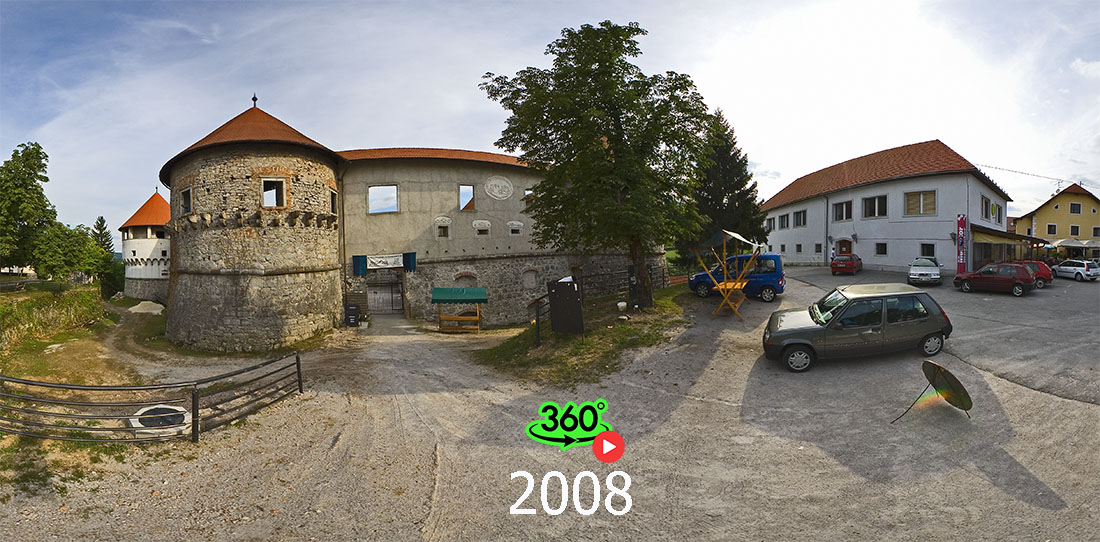
Today, Žužemberk Castle stands as the cultural, event, and tourist centerpiece of Suha krajina. Each summer, the courtyard hosts the flagship Trški dnevi (Market Days), medieval festivals, concerts, and theatrical performances, drawing numerous domestic and international visitors.