

Ormož Castle is one of the most important castle complexes in northeastern Slovenia and the central historical landmark of the town of Ormož. Its present appearance is the result of more than seven centuries of development – from a medieval border fortress to a representative noble residence and a modern cultural centre. Owing to its position above the Drava River and at the crossroads of major routes, the castle held significant military, administrative, and economic importance for centuries.
Geography and Location
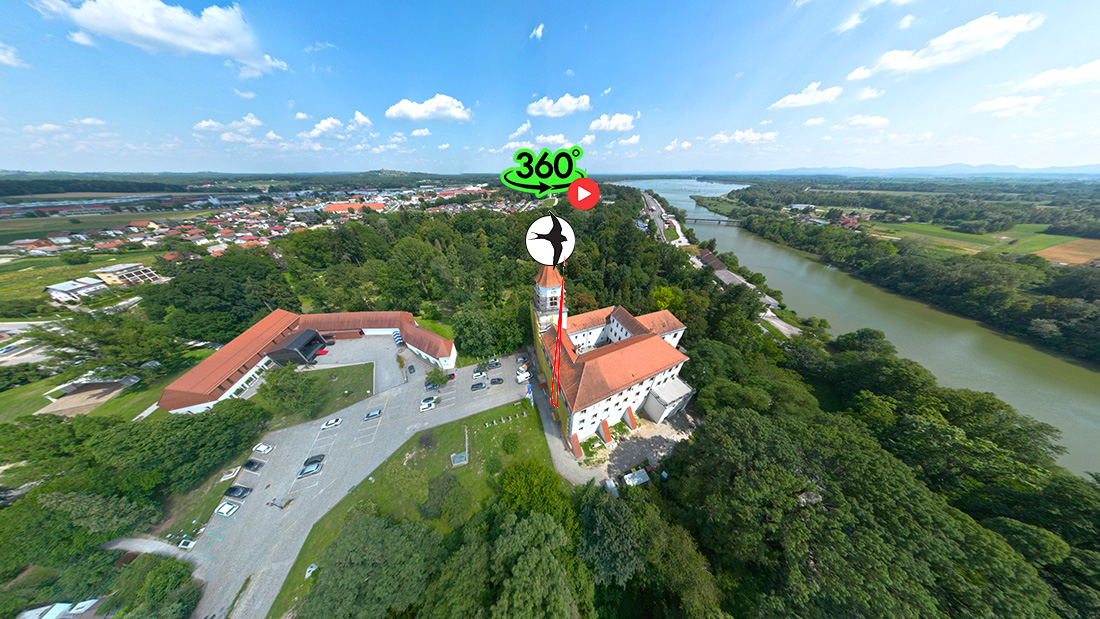
The castle stands in the eastern part of Ormož’s old town, on a natural promontory overlooking the Drava valley. The location was chosen deliberately: the promontory offered a natural defensive advantage, with steep slopes falling away to the west, south, and east, further protected by a defensive moat. Ormož lies on the transitional zone between Prlekija and the Drava plain, close to today’s Slovenian‑Croatian border. Archaeological research confirms settlement here as early as around 2100 BC, while in the Late Bronze Age the area was among the largest settlements of the Eastern Alpine region.
The castle is also embedded in a spacious castle park, designed in the early 20th century and featuring several exotic tree species that form an important part of its identity.
History
Origins and the Middle Ages (13th–15th century)
The beginnings of the castle date to the last third of the 13th century. After 1278, King Rudolf of Habsburg granted Friderik of Ptuj permission to build a fortress on this strategic border. The castle originally bore the German name Friedau, after its founder from the Lords of Ptuj. Its oldest part was the defensive tower – the bergfried – which still represents one of the most distinctive architectural features of the complex. It housed an early Gothic chapel with an apse, considered one of the best‑preserved examples of medieval castle sacral architecture in Slovenia. Residential and service wings were gradually added around the tower.
Turkish Raids, Fires, and Rebuilding (15th–18th century)
In 1487 the castle was burned during military conflicts and soon afterwards taken over by the Szekely family, who began extensive reconstruction and gave it a more representative character. The Turkish incursions of 1532 prompted further fortification, integrating the castle into the town’s defensive system. In the following centuries it was owned by the Herberstein family and later by the Hungarian noble family Pethe, who significantly shaped its Baroque transformation.
In 1704 the castle was plundered and burned again during the Kuruc uprising. A major reconstruction followed, turning the former fortress into an early Baroque residence with arcaded corridors and a more comfortable interior layout.
Classicist Renovation and the Last Owners (19th–20th century)
In the early 19th century the castle passed to Jožef Pauer, who renovated it in the Classicist style. Particularly notable are the wall paintings from 1810 by Austrian painter Alois Gleichenperger, among the finest Classicist murals in Slovenia. Later the castle became the property of the Wurmbrand‑Stuppach counts, its last private owners, who arranged the park, chapel, and modernised parts of the estate.
After the Second World War the castle came under public administration and gradually assumed cultural functions. Since the 1990s a systematic restoration has been underway, including the tower, façades, roofs, courtyard, well, and most representative interiors.
Architecture
Today the castle combines Baroque and Classicist elements, while its core remains distinctly medieval. It consists of four two‑storey wings arranged around an inner courtyard with a well. The imposing bergfried and the arcaded corridors are among its most recognisable features. The interior includes former reception salons, a dining hall, library, and notable illusionistic murals, while the former knights’ hall now serves as a venue for events.
Present Use
Ormož Castle is now a multifunctional cultural and tourist centre. It houses museum collections, gallery spaces, a library, and various cultural programmes. Part of the activities is run by the Ptuj–Ormož Regional Museum, which presents the history of the wider region.
Visitors can explore:
– restored castle rooms – Classicist murals – permanent historical and ethnological collections – exhibitions of contemporary art – the castle tower with views of Ormož, the Drava River, and Prlekija – the castle park and outbuildings
The castle hosts concerts, weddings, film screenings, exhibitions, and numerous cultural events. In 2022 it received the Green Key certificate, highlighting its sustainable management as a cultural heritage site.