

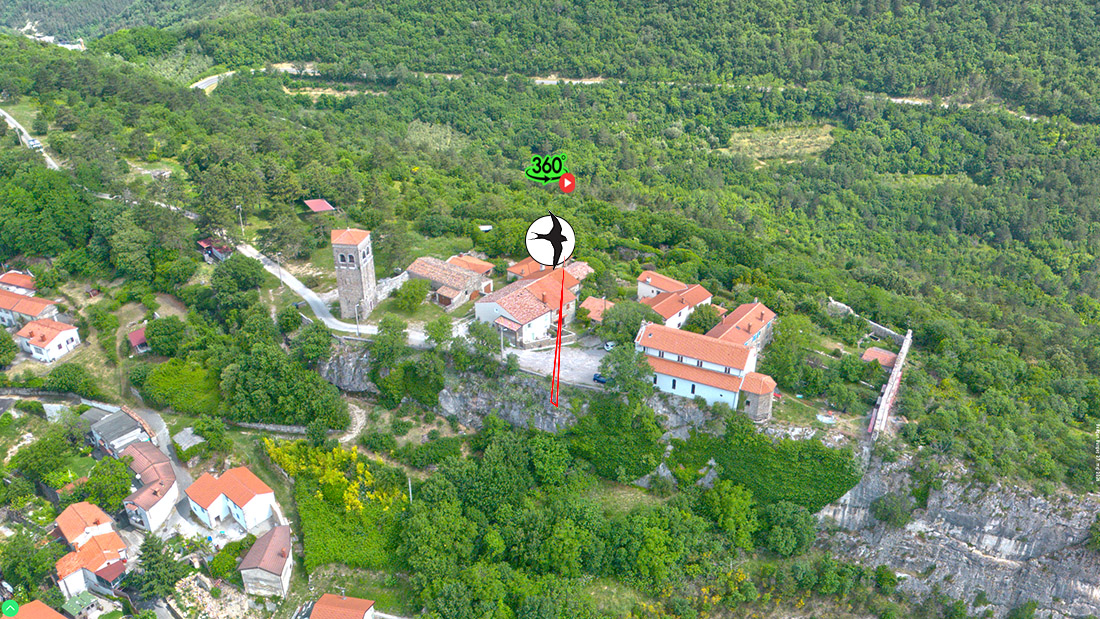
Kubed is an Istrian village situated on the northeastern edge of the Šavrin Hills, where the flysch and karst landscapes meet. It lies on the sunny slope of the Grad hill at an elevation of about 230 metres, between the ridges of Krašca and Kubejska Varda, which gives it a commanding view over the valley stretching between Gračišče and Buzet. This position has been strategically important throughout history, as it controlled routes between the coast and the interior of Istria.
Settlement of the area is confirmed as early as prehistory and the Roman period, while the first written mention of Kubed dates to 1069, when it appears in a charter issued by Emperor Henry IV. In the Middle Ages, the village belonged to the estates of the Bishopric of Trieste and later became an important defensive point against Ottoman and Uskok incursions. In the 15th and 16th centuries, a fortified tabor stood here, providing refuge for the local population. In the 19th century, Kubed became the site of a significant national gathering, where locals demanded a United Slovenia and the introduction of Slovene in public life.
The most recognisable landmark is the medieval fortification on the Grad hill, featuring a rare pentagonal defensive tower, today serving as the bell tower of the Church of St Florian. The church stands just above the village and preserves part of the former defensive wall. Kubed is also home to the Church of St Michael by the cemetery, a late‑19th‑century roadside chapel, and the birthplace of Alojz Kocjančič, the first notable Slovene poet from Istria.
Today, Kubed combines a rich historical heritage, a distinctive landscape identity, and well‑preserved cultural monuments that give the village its unique character.
The medieval fortification on the Grad hill above Kubed is one of the most remarkable defensive monuments in Slovenian Istria, combining an exceptionally strategic position, a rare architectural design, and a layered historical legacy. Built on a naturally exposed ridge rising above the Gračišče–Kubed valley, the fort’s location itself dictated its defensive purpose. From this vantage point it was possible to control the routes connecting the coast with the interior of Istria and the Buzet area, a factor of great importance in times marked by frequent military conflicts.
At the heart of the fort stands a pentagonal defensive tower, an architectural rarity in the wider European context. The tower was designed as the entrance structure of the fortified tabor, which in the 15th and 16th centuries served as a key defensive point against Ottoman incursions and Uskok raids. During periods of danger, the inhabitants of surrounding villages sought refuge within its walls. The tower functioned both as a lookout and as the last line of defence. Its pentagonal shape allowed for improved surveillance of the surroundings and more effective protection, as defenders could cover several directions at once.
The fort was originally enclosed by defensive walls, within which stood auxiliary buildings, storage areas, and shelters. Over time, as its military role diminished, the tower underwent a transformation: in the 19th century it was heightened and incorporated into the Church of St Florian as its bell tower. Despite this change, it has preserved its distinctive form, which still clearly reveals its original defensive purpose. The remains of the walls and the outline of the former tabor are still visible today, offering insight into the medieval design of defensive posts in Istria.
Today, the fort on Grad stands as an important cultural and historical monument, allowing visitors to understand the defensive systems of the Istrian hinterland while also offering an exceptional view of the surrounding landscape. Its silhouette rising above the village remains a symbol of Kubed and a vivid reminder of a turbulent past in which the boundary between safety and danger was often very thin.