 aerial

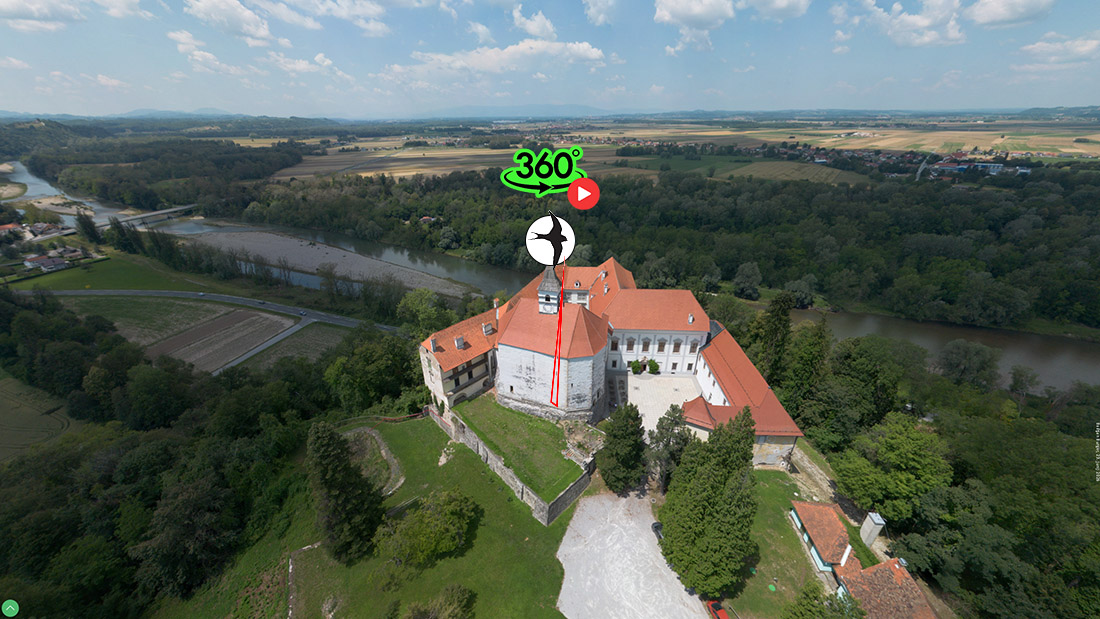
Borl Castle stands in northeastern Slovenia, in the settlement of Dolane in the Municipality of Cirkulane, on the western edge of the Haloze hills. It is built on a prominent, steep limestone outcrop high above the Drava River, directly beside what was once an important river crossing. Owing to its exposed position, the castle controlled traffic, trade routes, and defensive passages for centuries—between Ptuj, the Haloze region, Croatian Podravje, and the former Hungarian territories.
The castle’s silhouette is highly distinctive in the landscape; rising above the plain, it is visible from afar and is often described as the symbolic “gateway to Haloze.” Its location at the transition between the fertile Drava lowlands and the wine‑growing slopes of Haloze enabled effective oversight of both agricultural land along the river and the surrounding vineyards.
History
The origins of Borl Castle reach at least back to the 12th century, although archaeological and topographical assumptions suggest that the area may have been significant already in Roman times—possibly hosting a fort and a crossing over the Drava on the route between Poetovio and Pannonia. In the medieval period, Borl served as a fortified border post on the Hungarian–Styrian frontier.
Early sources refer to the castle as Ankenstein (German) and Borlyn (Hungarian). Over the centuries it changed owners several times and gradually evolved from a military stronghold into a noble residence. A key period came in the 17th century, when the Sauer family thoroughly remodelled the castle into a Baroque residence with representative halls, arcaded courtyards, and the richly furnished Chapel of the Holy Trinity.
In 1801 the castle passed to the Wurmbrand‑Stuppach family, who continued renovations and interior improvements. At the turn of the 20th century Borl remained an aristocratic residence, but political changes after the First World War led to the sale of the estate to the Borlin joint‑stock company.
Modern History
Events of the Second World War left a deep mark on the castle. The occupying authorities used the building as a gathering and holding site for political prisoners—an important yet long‑overlooked chapter of Borl’s history.
After the war the castle was nationalised and lost its original function. In 1951 it was given a completely new role as a tourist resort. During the following decades Borl experienced remarkable growth: it housed a restaurant, guest rooms, social events, and in 1962 even an outdoor swimming pool. In the 1960s and 1970s it became one of the most recognisable excursion destinations in the wider Ptuj region.
The resort closed in the late 1970s, around 1980. Due to changing traffic patterns, high maintenance costs, and shifting tourism trends, the castle began to deteriorate and remained without a permanent function for several decades.
Restoration
A turning point came after 2005, when the Society for the Revitalisation of Borl Castle was founded. Together with the local community, it persistently highlighted the importance of preserving the complex and encouraged its revitalisation.
Today the castle is owned by the Republic of Slovenia and holds the status of a cultural monument of national importance. In 2020 a major state‑funded restoration began. The first phase included structural stabilisation, roof and courtyard renovation, and the refurbishment of selected interior spaces. After the completion of works, the castle reopened to visitors in 2024.
The restoration focused not only on the physical conservation of the building but also on re‑establishing meaningful content and connecting cultural heritage with the natural landscape of the Drava River and the Haloze region.
Present Use
Borl Castle today functions as a multi‑purpose cultural and tourist venue. Visitors can explore renovated castle rooms, arcaded courtyards, a panoramic terrace, and the Chapel of the Holy Trinity.
A central feature is the permanent natural‑history exhibition zDravo, dedicated to the Drava River, its wetlands, fish species, birds, and the biodiversity of the Natura 2000 area. The former swimming‑pool zone has been transformed into a natural wetland habitat.
The castle hosts cultural events, lectures, concerts, weddings, workshops, and guided tours, and also includes a castle café. Borl is once again becoming an important cultural centre on the edge of Haloze—no longer as a fortress or a resort, but as a place of heritage, interpretation, and experience, connecting history, nature, and local identity.