

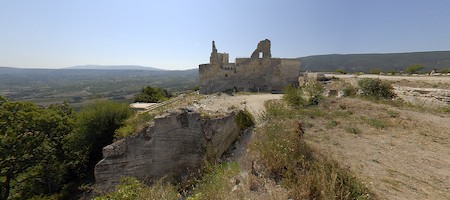
Lacoste is a picturesque medieval village perched on a prominent hill above the broad plain that stretches between the plateau landscape of Vaucluse to the north and the Luberon mountain massif to the southeast. Thanks to its elevated position, the settlement served early on as an important lookout point and a naturally fortified nucleus of habitation. The first written records mentioning the village date to the year 1056, confirming its long and continuous historical presence in the Provençal landscape. Over the following centuries, Lacoste developed around its castle, with narrow stone lanes, tightly clustered limestone houses, and a distinctly Mediterranean atmosphere that has been preserved to this day.
The village is dominated by the Château de Lacoste, which was rebuilt and reinforced several times throughout its history. In the late 18th century it became the refuge of the notorious Marquis de Sade, an aristocrat, playwright, and writer whose erotic and philosophical works pushed far beyond the moral boundaries of his era. His residence in the castle left a particular historical imprint on the place: Lacoste became a setting where austere medieval architecture meets the provocative intellectual legacy of the Enlightenment. Although the castle was partially destroyed during the French Revolution, its remains still testify to its former grandeur and to the period when the Marquis de Sade, from its solitude, observed the Luberon landscape and wrote works that would later become part of European literary history.
Today, Lacoste is known for its exceptional cultural atmosphere, restored stone streets, views over vineyards and lavender fields, and a lively artistic pulse strengthened in the 20th century by the presence of artists and art students. The village thus combines historical depth, architectural authenticity, and contemporary creativity, making it one of the most captivating places in the heart of Provence.
author: Boštjan Burger