

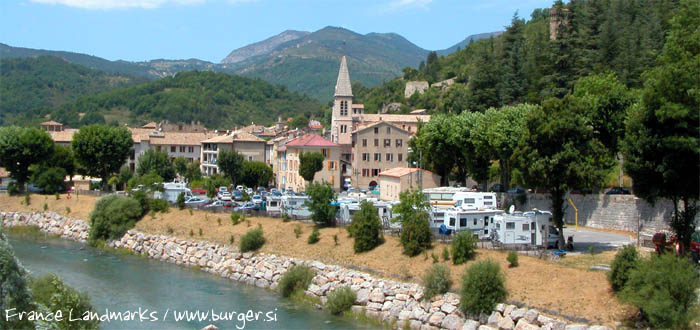
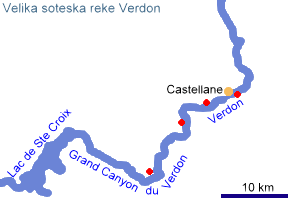
Castellane lies in the Alpes-de-Haute-Provence department at an elevation of about 740 m, positioned at a key transition between the high Provençal plateaus and the entrance to the famous Grand Canyon du Verdon. Its location is distinctly strategic: the settlement stands at the junction of routes coming from Digne-les-Bains, Grasse, and the Alpine passes to the north, and it is the nearest larger town on the western edge of the canyon. Because of this, Castellane has for centuries served as a natural starting point for travel, trade, and today especially for tourism.
Geographic setting
The town is situated in the narrow valley of the Verdon River, which here has not yet carved fully into the limestone plateaus but already shows its characteristic turquoise colour caused by dissolved limestone. The coordinates (43°50' N, 6°30' E) place Castellane in the heart of the southern Alps, where Mediterranean influences blend with mountain climate. Summers are warm but not excessively hot, while spring and autumn are fresh, often marked by strong winds descending through the valley.
A town beneath a towering rock
The most recognisable feature of Castellane is the 150‑metre limestone cliff known as the Roc, rising directly above the old town centre. The houses are literally pressed beneath it, giving the settlement a dramatic, almost fortified appearance. At the top stands the small yet striking chapel Notre‑Dame du Roc, which has been a pilgrimage site and a symbol of the town for centuries. The ascent is short but steep, and the summit offers a remarkable panorama of the Verdon valley, the old town, and the surrounding mountain ridges.
Historical background
Castellane has a long history reaching back to Roman times, when the valley served as an important route between the Alps and Provence. In the Middle Ages the town acquired a fortified character, still visible in the layout of its streets and remnants of defensive walls. Its position exposed it to constant movement of merchants, pilgrims, and later travellers heading toward the high plateaus and deeper into the Alps.
A centre for water sports
Today Castellane is one of the principal starting points for rafting, kayaking, and other white‑water activities on the Verdon. In this section the river is still wide and lively enough to allow various water sports, yet close enough to the canyon that visitors can combine an adrenaline‑filled descent with an excursion into the deepest parts of the gorge. Several specialised outdoor centres operate in the town, offering guided tours, equipment, and training.
A destination for hikers and explorers
Beyond water sports, Castellane is also popular among hikers. Numerous trails begin in or near the town:
-
towards viewpoints above the canyon,
-
across the Champsaur plateau,
-
along the rugged limestone ridges surrounding the valley.
The ascent to Notre‑Dame du Roc is the shortest and most symbolic route, while longer trails lead to vantage points overlooking the entire Verdon valley.
Contemporary character
Despite its strong tourist pulse, Castellane has preserved the appearance of a small Provençal town: narrow streets, stone houses, intimate squares, and a lively weekly market. In summer it is full of hikers, cyclists, and rafters; in winter life slows down, yet remains pleasant thanks to the mild climate and proximity to natural parks.
author: Boštjan Burger