

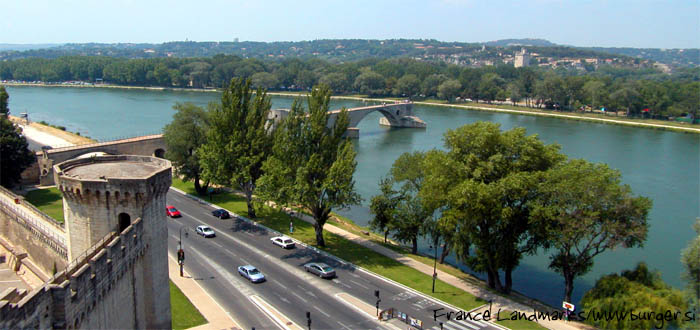
Avignon is a city in southeastern France, situated at the confluence of the Durance and Rhône rivers, a location that has given it exceptional strategic importance throughout history. The Rhône served as a major route between the Mediterranean and inland Europe, while the Durance connected Provence with the Alpine passes. Today, the wider urban area has around 180,000 inhabitants, and Avignon remains one of the key cultural and historical centres of southern France.
Geographical Setting
The city stands on the left bank of the Rhône, on a slightly elevated terrace naturally protected from flooding. Thanks to its position, Avignon became an important trading hub early on, where routes between Provence, the Rhône Valley and the Alpine hinterland intersected.
History
In the time of the ancient Gauls, Avignon was the most important settlement in the region. After the Roman conquest it lost its leading role, yet remained part of the administrative and commercial network linking southern Gaul with the rest of the Roman Empire.
During the Middle Ages the city experienced renewed growth. The inner urban core is still surrounded by approximately five kilometres of city walls, consisting of 39 defensive towers and seven gates. This is one of the most complete and best‑preserved medieval fortifications in Europe.
Between 1309 and 1377 Avignon served as the seat of the popes. This period brought the city immense political, economic and cultural influence. The most magnificent remnant of that era is the Papal Palace, one of the largest Gothic buildings in Europe, which functioned as a residence, administrative centre and symbol of ecclesiastical power.
A special place in Avignon’s history belongs to the Saint‑Bénézet Bridge, built in the 12th century. The bridge was repeatedly damaged by floods of the Rhône, yet it was continually repaired. In the 17th century, specifically in 1669, the river destroyed it once again; due to high costs and recurring damage it was never rebuilt. Today, four remaining arches of the former bridge survive and have become one of Avignon’s most recognisable landmarks.
Present Day
Avignon is today a vibrant city that combines rich historical heritage with a lively cultural atmosphere. Its old town is listed as a UNESCO World Heritage Site, and its streets preserve a medieval layout interwoven with museums, galleries, cafés and squares.
The city is world‑famous for its summer festivals, especially the Festival d’Avignon, one of the most important theatre festivals in the world. Every July the city is filled with street performers, theatre companies and visitors from all over France and beyond. During this time Avignon transforms into a vast theatrical stage where tradition, experimentation and contemporary art meet.
author: Boštjan Burger