

Turku (Swedish: Åbo) is the oldest city in Finland, a former royal capital, and the spiritual heart of the country. Throughout the centuries, it has served as Finland's vital bridge to Western Europe. Its development from an early ecclesiastical outpost into a mighty industrial and academic hub embodies the entire history of Finnish nationhood.
Geographical Features and Climate of Turku
Turku is situated on the southwestern coast of Finland, at the confluence of the tectonically stable mainland and the shallow Archipelago Sea (Saaristomeri). The city center developed around the lower reaches of the Aura River, which originates in the Finnish interior and flows into the Baltic Sea after 70 kilometers. The Aura River is not merely a geographical divider but the historical and cultural backbone of the city. To this day, residents use the traditional idioms "täl pual jokke" (on this side of the river) and "toispual jokke" (on the other side of the river) to distinguish the historic eastern bank from the later-developed western side.
-
The Uniqueness of the Archipelago: Extending directly from the city's gates is the Archipelago Sea, featuring over 40,000 islands, islets, and skerries. This natural labyrinth protects the harbor from heavy sea swells and winds while creating one of the most unique biotopes in Europe. Due to post-glacial rebound (isostasy), the region's coastline rises by approximately 40 to 50 centimeters each century, constantly reshaping the shoreline.
-
Climate Conditions: Due to its immediate proximity to the sea and prevailing southwestern winds, Turku experiences a transitional maritime-continental climate. Winters here are significantly milder than in central or northern Finland; average January temperatures hover around -4 °C to -6 °C, though the sea straits still frequently freeze over. Summers are moderately warm, with average July temperatures around 17.5 °C, and the area receives roughly 700 mm of precipitation annually.
Foundation and Medieval Flourishing
The roots of Turku trace back to the period of the First Swedish Crusade in the 12th century. The city's name itself derives from the Old East Slavic word turgu, meaning "marketplace." The official year of foundation is established as 1229, when Pope Gregory IX signed a papal bull authorizing the relocation of the bishop's see from Koroinen (slightly further upriver) to the current location by the Aura River, where a bustling commercial center was emerging.
-
Hanseatic Trading Post: In the 14th century, Turku joined the influential Hanseatic League trading network. The city became the primary export harbor for Finnish timber, fur, butter, and fish, with ships regularly sailing toward Lübeck, Gdańsk, and Stockholm.
-
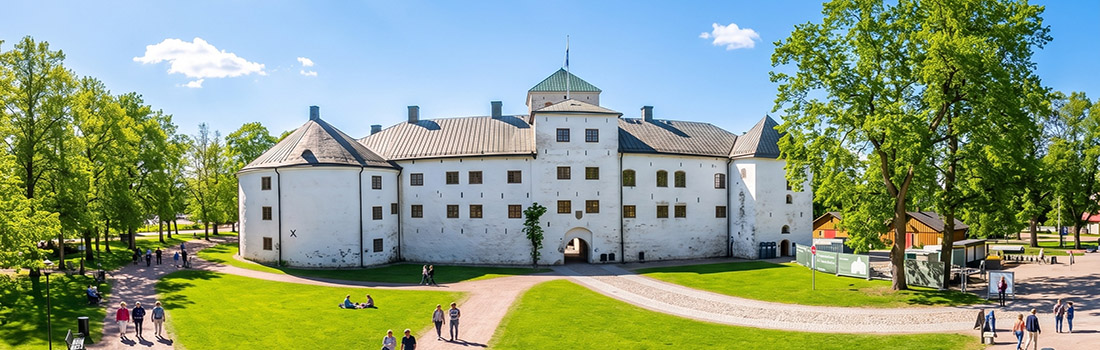
Center of Österland: During the era of the Kingdom of Sweden, Finland did not exist as an independent entity but rather as the province of Österland (Eastern Land). Turku was its undisputed political, administrative, and religious center. It housed the Bishop of Finland (later Archbishop), while the imposing Turku Cathedral (consecrated in 1300) and the royal Turku Castle were erected nearby to oversee navigation and tax collection.
Wars, Catastrophes, and the Loss of Capital Status
Owing to its strategic position on the Baltic Sea and its role as a frontier zone between Sweden and Russia, Turku was the stage for countless conflicts:
-
Medieval Raids: The city was completely plundered and torched by Novgorodian forces in 1318, and during the turbulent dissolution of the Kalmar Union in the early 16th century, it was repeatedly attacked and ravaged by Danish privateers.
-
The Era of the "Greater Wrath" (Isoviha): During the Great Northern War (1713–1721), the Russian army of Tsar Peter the Great occupied Turku. This period of brutal occupation triggered mass displacement, economic ruin, and halted state institutions. The city met a similar fate during the "Lesser Wrath" (Pikkuviha) from 1742 to 1743.
-
Russian Rule and Moving the Capital: Following the Finnish War (1808–1809), Sweden was forced to cede Finland to the Russian Empire. For the first few years, Turku served as the official capital of the newly established Grand Duchy of Finland. However, Tsar Alexander I deemed Turku geographically too close to Sweden and ideologically too loyal to the Swedish crown. In 1812, he issued a decree officially moving the capital to Helsinki, which was closer to Saint Petersburg.
-
The Great Fire of 1827 (Turun palo): The final and most devastating blow to the old city occurred on September 4, 1827. Due to negligence in a suburban household, a violent fire broke out, destroying more than 2,500 buildings—representing 75% of the city—in less than 24 hours. The priceless archives of the Royal Academy, the medieval wooden quarters, and most of the cathedral's interior were reduced to ashes. Following this catastrophe, the remaining state offices and the university were relocated to Helsinki. The city was subsequently rebuilt according to a strict, neoclassical grid plan designed by architect Carl Ludvig Engel, featuring wide avenues specifically intended to prevent the spread of future fires.
Population and Social Structure
Today, Turku has a population of just over 200,000 residents, while the total urban region (which includes the neighboring municipalities of Kaarina, Raisio, and Naantali) encompasses approximately 340,000 people. This positions it as the third-largest urban area in Finland (following the Helsinki metropolitan area and Tampere).
-
Bilingualism and Cultural Heritage: The city is officially bilingual. Finnish is spoken by approximately 87% of the population, while the Swedish-speaking community comprises just over 5% (around 10,000 people). This minority holds immense historical significance, maintaining its own school systems, media outlets, and university.
-
Demographic Trends: Turku is one of the demographically youngest cities in Finland, with students accounting for more than 20% of the total population. Over the last two decades, the share of international immigrants has risen rapidly (now standing at around 8%), driven primarily by employment in the high-tech sector and university enrollment.
Today's Role of Turku
Economy and Key Industrial Sectors
The economy of Turku is driven by high technology, heavy industry, and international logistics. The city forms the southern hub of Finland's maritime and technological development.
-
Heavy Maritime Industry: The Meyer Turku shipyard is one of the largest employers in the region. It specializes in designing and constructing the world's largest, most ecologically advanced cruise ships (such as the Oasis and Icon classes).
-
Life Sciences: The Turku Science Park district hosts the so-called BioValley, where more than half of Finland's pharmaceutical and biotechnology industry is located. This cluster focuses on developing modern medicines, diagnostic equipment, and functional foods.
-
Logistics Hub: The Port of Turku handles the lion's share of ferry passenger and cargo traffic between Finland and Sweden. Millions of passengers travel through the port annually, with regular liner connections linking Turku to Stockholm and the Åland Islands via Långnäs.
Education and Scientific Research
Turku is the cradle of Finnish science and education. Today, its higher education ecosystem comprises three key institutions with over 40,000 students:
-
University of Turku (Turun yliopisto): Established in 1920 as the first fully Finnish-language university in the country, it is now a highly regarded research institution with strong faculties in medicine, natural sciences, and humanities.
-
Åbo Akademi University: Founded in 1918, it is the only exclusively Swedish-language university in Finland outside the autonomous Åland Islands.
-
Turku University of Applied Sciences (Turku AMK): Focused on engineering, business, and healthcare, maintaining deep ties with local industries.
Culture and Social Life
As a former European Capital of Culture (2011), Turku offers an exceptionally vibrant arts scene:
-
Museum Treasures: Key museums include Aboa Vetus & Ars Nova (a unique museum combining the underground archaeological excavations of the medieval city with contemporary art), the Turku Art Museum (showcasing classic Finnish art), and the Luostarinmäki Handicrafts Museum—the only residential quarter to entirely survive the Great Fire of 1827, where artisans in authentic wooden houses demonstrate traditional 18th- and 19th-century crafts.
-
The Official Christmas City: Turku holds a special status in Finland. Every year on December 24th at noon, the "Declaration of Christmas Peace" is officially read from the balcony of the Brinkkala Mansion. This tradition has continued uninterrupted since the Middle Ages and is broadcast live, watched by the vast majority of Finns.
-
Music and Festivals: The city hosts Ruisrock, held on the island of Ruissalo, which stands as one of the oldest continuous rock festivals in Europe (running since 1970), as well as the premium *Turku Music Festival*, which highlights classical music and opera.
Tourism and Landmarks
The tourist appeal of the city relies on the synergy between historical patina and the modern pulse along the Aura River.
-
Turku Cathedral (Turun tuomiokirkko): The national shrine of the Evangelical Lutheran Church of Finland. It is the country's only genuine medieval basilica and serves as the burial site for many historical figures, including Swedish Queen Karin Månsdotter.
-
Culinary River Scene: The banks of the Aura River burst with life during the summer months. Old passenger and cargo vessels have been converted into floating restaurants and bars. Crossing the river is the iconic little free ferry Föri, which has been shuffling pedestrians and cyclists between the banks since 1903.
-
The Archipelago Trail (Saariston rengastie): Turku serves as the main gateway for this world-famous tourist route, which uses a system of bridges and local ferries to allow cyclists and drivers to take a circular journey through the wild, pristine archipelago of southwestern Finland.