

The rock paintings at Astuvansalmi are not only the largest in Finland but also represent one of the key monuments of prehistoric art in the entire wider Baltic Sea region. Located in the pristine wilderness of the South Savo region, they offer an invaluable insight into the material and spiritual world of the Neolithic communities of Northern Europe.
Geography and the Natural Phenomenon of the "Stone Face"
The sanctuary is situated on the shores of Lake Yövesi, a part of the vast Saimaa lake system – the largest lake complex in Finland. Administratively, the area belongs to the former municipality of Ristiina, which is today part of the city of Mikkeli.
The main reason ancient hunter-gatherers chose this specific cliff was its natural shape. When viewed from the water's surface from a certain distance, erosion and natural fractures combine to form a distinct, monumental profile of a human face or head. During the Neolithic era, when animism (the belief that all nature, including rocks, possesses a soul) formed the foundation of the spiritual world, such a cliff was considered the dwelling place of powerful spirits and functioned as a natural temple.
History, Geology, and Precise Dating
The age of the paintings at Astuvansalmi is estimated to be between 3000 and 1300 BC. They were created during the Late Stone Age (Neolithic) and continued into the Early Bronze Age.
The dating of rock paintings in Finland is unique because it is closely linked to the geological phenomenon of post-glacial rebound (the land rising after the melting of the ice sheet). Around 4000 BC, low water pressure broke through a new outlet to the southeast – creating the Vuoksi River, which caused a sudden and significant drop in the water level of the Saimaa system by approximately 4 meters.
Only after the water level stabilized at this new, lower level did the cliffs of Astuvansalmi become suitable for painting. The artists worked either from boats or stood on the frozen lake ice during winter. The oldest drawings are located highest on the cliff (approximately 11 meters above today's water level), while the youngest are closer to the water (around 5.5 meters above today's level). As the water level continued to recede over the centuries, the original paintings became unreachable.
Chronology of Discovery and Research
Although local fishermen and residents had known about the unusual red stains on the cliff for generations, they had always attributed them to natural processes or lichens.
In the summer of 1968, Finnish archaeologist Pekka Sarvas officially recognized the significance of the site and scientifically confirmed that these were ancient paintings made of red ochre. The discovery sparked a wave of interest in Finnish prehistoric art.
During underwater investigations conducted between 1989 and 1990, archaeological divers discovered arrowheads directly beneath the paintings on the lake bed, and most notably, two small amber pendants shaped like human faces. Since amber does not naturally occur in Finland and was brought from the Baltic region, this proves that Astuvansalmi was an important pilgrimage site and trading hub for the wider Baltic area, where people made offerings of valuable items to the lake deities.
Symbolism of the Motifs
Around 70 individual figures have been identified on the rock wall. They were made from a mixture of red ochre (iron oxide) and a binding agent, most likely egg white, blood, or animal fat. This mixture penetrated the pores of the granite and became covered over millennia by a thin, protective layer of silicon dioxide, which has preserved the paintings to this day.
-
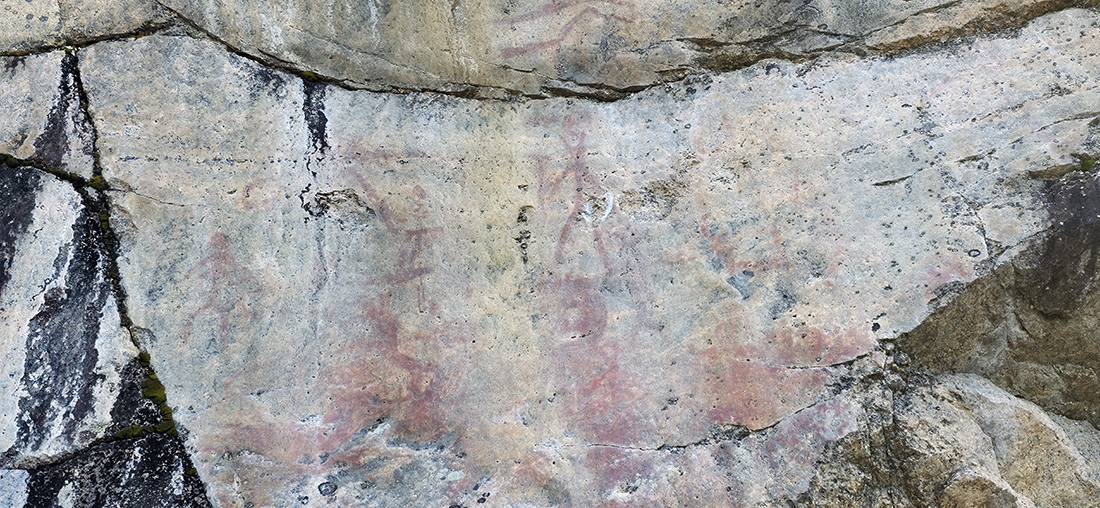
Elks (at least 18 figures): These represent the dominant motif. They often feature an exaggerated hump on their back and a "life line" or heart drawn inside the body.
-
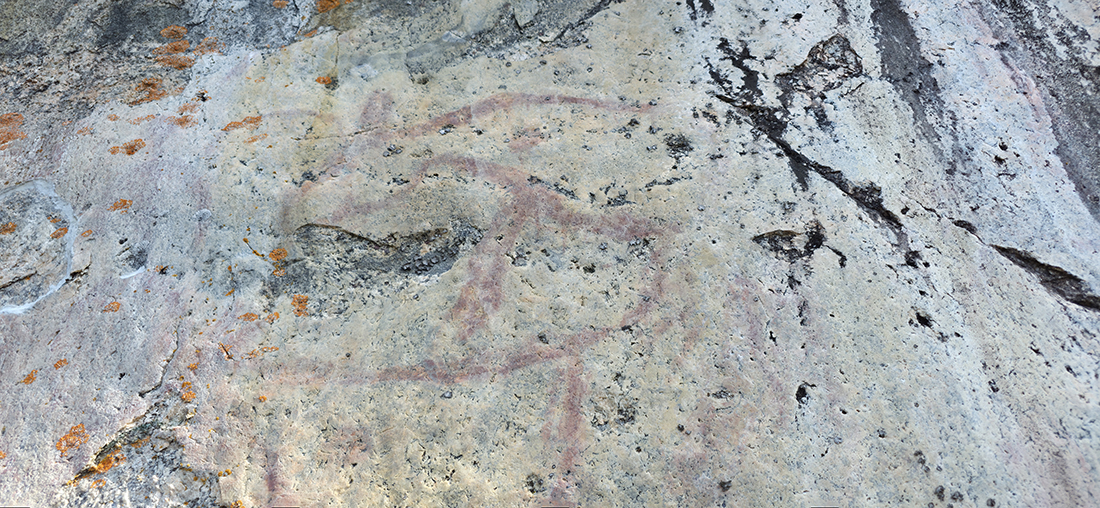
Human Figures (at least 20 figures): Mostly male silhouettes, some showing horns on their heads, which suggests shamanic rituals and transformation into animals.
-
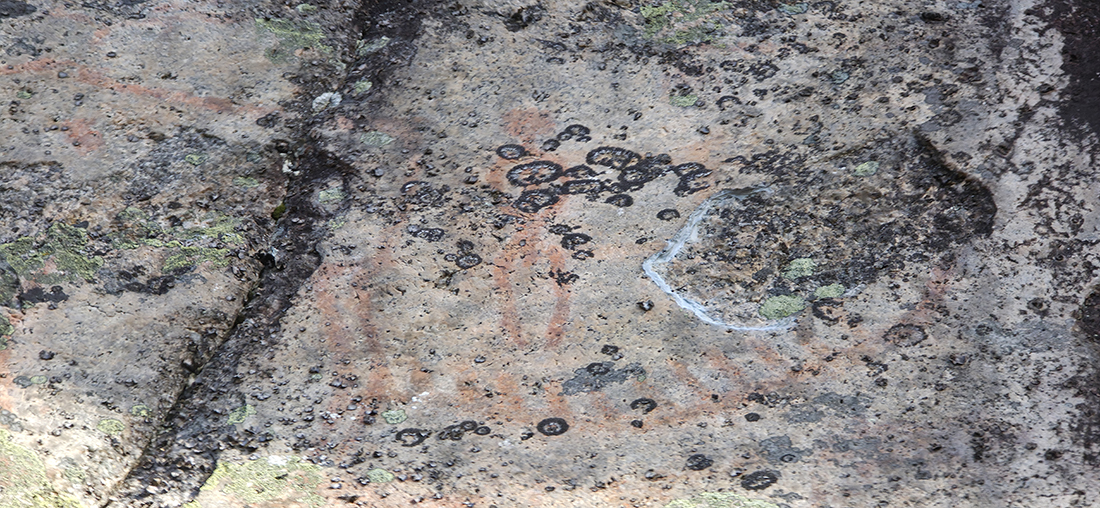
The "Astuva Woman" (Astuvansalmen nainen): One of the most famous prehistoric drawings in Finland. It features a female figure depicted in profile holding a bow. In Finnish mythology, she is often associated with Tellervo, the goddess of the forest and hunting.
-
Handprints and Boats: Left handprints symbolize a ritual connection between humans and the rock. The drawings of boats often feature vertical lines representing the crew on board.
Access and Visitor Guide
The location is accessible year-round, though the best time to visit is between May and October when the trails are clear of snow and the lake is navigable. The site can be reached either by land or by water.
1. Overland Access via the Nature Trail (Astuvansalmen luontopolku)
-
Starting Point: Drive from Mikkeli along road no. 62 towards the southeast (direction Puumala). After about 15 km, turn right onto Yövedentie (road no. 4321) towards Suchas/Astuvansalmi. Follow the brown tourist signs for "Astuvansalmen kalliomaalaukset" to the designated parking lot at the end of the road.
-
Trail Description: The Astuvansalmi Nature Trail leads from the parking lot and is approximately 3 kilometers long each way (a total of 6 km round trip, taking about 40 to 50 minutes one way). The path winds through a typical Finnish taiga forest, over rocks and blueberry patches. Most of the route follows a well-trodden forest path filled with roots and small rocks. Wooden steps and boardwalks (pitkospuut) are installed on the steepest or wettest sections. The final stretch is the steepest as the trail descends to the shore of Lake Yövesi. Sturdy athletic or hiking footwear with good grip is essential.
-
Destination: The trail ends at a wooden viewing platform built directly beneath the mighty granite wall, allowing a safe, close-up view of the paintings.
2. Access by Water (Boat / Kayak)
Because the paintings face the lake and were originally viewed from the water by ancient people, approaching by boat is visually the most impressive method. During the summer season, tour boats and water taxis operate from the nearby harbor in Ristiina. For independent paddlers, there is a small dock by the cliff where you can tie up a kayak or boat and step onto the wooden viewing platform.
Important notice for visitors: It is strictly forbidden to touch the rock paintings, as the oils and acidity of human skin accelerate the deterioration of the millennia-old ochre pigment. Scratching, carving, or writing on the rock face is also strictly prohibited.